🇨🇳🤖 But who's going to die first: them or us?
Bloomberg: AI Threatens to Make China’s Jobs Slump Much Worse:
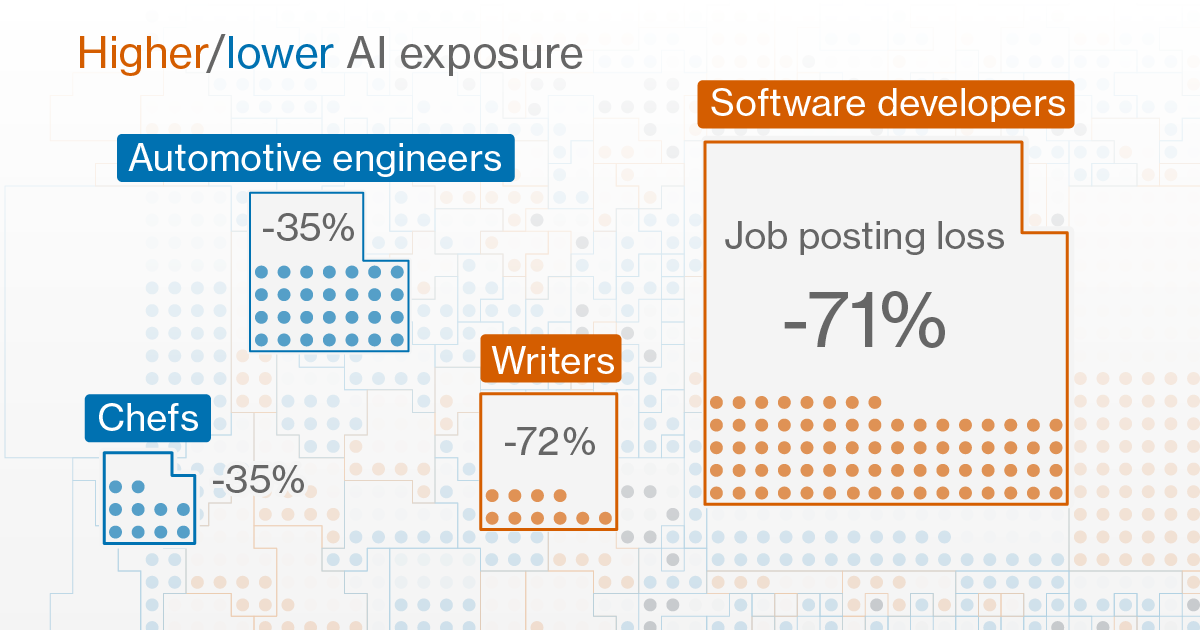
In several separate studies, scholars from Chinese universities found that positions with higher AI exposure correlate with weaker hiring, especially for entry-level jobs.
Chen Qin, a Chinese data scientist and visiting scholar at ShanghaiTech University who led a review of 116 million online job ads, estimated that AI resulted in a 5.2% net loss in new hiring between 2023 and early 2026. The impact was most acute in positions that required one to three years of experience. Nearly a fifth of the postings had a significant change in responsibilities over that period.
Another study overseen by researchers from institutions including the Chinese Academy of Social Sciences — which reports into the State Council, headed by Premier Li Qiang — estimated that AI led to a 21% decline in the average number of online job postings, as well as a 4% drop in average salary.
Unlike in the US, Chinese firms have largely resisted acknowledging any link between job cuts and AI for fear of angering the government and the public. Tech firm Xiaomi Corp., food delivery giant Meituan and Fliggy, Alibaba Group Holding Ltd.’s travel unit, all denied Chinese media reports of mass layoffs this year. But several workers at top tech firms told Bloomberg News about rounds of layoffs that began in the spring, with as many as 30% of employees affected in some departments.
Justin Li, a 36-year-old user interface and experience designer in Hangzhou, was let go in June by an internet giant along with almost half his team of 15 people. Blaming the layoffs on AI and China’s slowing economy, he’s applied for hundreds of positions since June without success. What’s worse, he took out a mortgage to buy an apartment when home prices peaked in 2021, only to see its value plunge by 40%.
“I have no choice but to suppress my desires and spending,” Li said. “I came to accept my own mediocrity and that I’m just an average person.”
A broader slowdown is compounding the struggles of Li and others seeking employment: China created just 21 million net new jobs in the five years to 2024, according to the World Bank, less than half the number in the prior half-decade. Government efforts to expand college admissions during the Covid-19 outbreak means a cohort the size of a European country — more than 70 million recent graduates dubbed the “lost generation” by consultancy Gavekal Dragonomics — is arriving in the labor force at the worst moment.
The topic of AI job losses is sensitive in China. Even in closed-door meetings, Chinese policymakers are reluctant to divulge their views, according to policy advisers and government-affiliated economists who spoke to Bloomberg. Some researchers fear they might irk authorities if their comments or reports appear too negative or risk inducing panic.
Behind the public stonewalling, the Communist Party is on alert for widespread job losses that risk generating anger and instability. So far, China’s sweeping apparatus to neutralize dissent has prevented the despair from turning into protest, with many young people coping by “lying flat” — doing the bare minimum or giving up on ambition altogether.
But officials have shown heightened concern over the issue, according to several people familiar with the matter, who asked not to be identified because they weren’t authorized to speak to the media. In June, China’s cabinet announced a plan to conduct an unprecedented nationwide survey to track the impact of AI on jobs over the next five years. Last month, it called for “prudent management of the pace of AI adoption in labor intensive industries” in order to minimize the blow to workers.
...
For young people who fear being left behind, dozens of new AI training centers like the one in Hangzhou offer a potential path to a stable job. They target a few specific jobs, including engineers that help companies run AI models and directors that make films using the technology.
The hometown of DeepSeek and Alibaba, Hangzhou is arguably ground zero for China’s AI transformation. The training center — officially known as Zhejiang Digital Technology Talent Employment Training Base — is seeing a surge in demand as AI starts to hit the job market. Administrators expect to enroll 8,000 students this year, up from 5,000 last year.
...
The job offers in particular are a powerful draw. Nearly 11% of college graduates last year throughout China were still jobless six months after finishing university — almost three times the share a decade ago, according to a survey by Mycos, a Beijing-based education consultancy.
Apart from tech programmers and designers, AI has also upended China’s film industry. The rapid spread of AI-made microdramas — TikTok-style soap operas lasting 90 seconds per episode watched on phones, which became a multibillion dollar business in the wake of the pandemic — has all but wiped out opportunities for actors, directors and anyone who worked on filming.
The Linying Studio in a Hangzhou suburb epitomizes the meteoric rise and abrupt fall of human-made shows. The filming venue, which takes up half a floor in a former furniture mall, opened in late 2023 backed by government investment to attract microdrama crews. At its peak, hundreds of people worked there simultaneously.
Now the studio sits empty most days, with at most one team on site, according to an executive. The sets — luxury homes, hospitals and police stations — were quiet on a recent afternoon. With AI video-generation tools like ByteDance’s Seedance 2.0, the time and cost required to create a show plummeted. More than 90% of 430,000 Chinese microdramas launched in the first eight months of 2026 were AI-generated, according to official data.