
Handwriting is fitness for the brain, they say (uni-ball agrees)
I am a scribbler in the literal (not literary) sense: I need paper to organize my thoughts and to make lists or just to jot down something, even if eventually I’ll use some software (not for shopping lists, though; not anymore).
How can people not use paper and a writing instrument?! (No, not you, retarded TikTokers, I wasn’t addressing to you.) Handwriting really is fitness for the brain! Here’s a study published in 2025. And an article from the May 2024 issue of Scientific American. Or, in Nature, a short article from this year (barrier-free).
I don’t use pencils as often as I should. Graphite pencils, stupidly called lead pencils in English, despite containing 0% Pb. But I use a (cartridge-powered) fountain pen way too frequently! I’m a Luddite, ain’t I?
At any time, I use a plethora of ink-based or gel-based writing devices, and I even carry with me at all times an irreplaceable BIC Crystal ballpoint pen medium, black. I’m a maniac.
Having had a long life so far, I’ve used so many brands and models of pens that I can’t remember them all. What I do remember is that I still miss the 0.5mm BIC Z4+ Needle Point pens that seem to have been discontinued.

The BIC Triumph 537R (also capped) liquid ink rollerball in 0.5mm didn’t offer the same writing quality the last time I used it (it might have been discontinued, too). Just to clarify: 537R uses liquid ink, whereas 537RT is gel-based (and retractable).
To cut the crap and get to the present day, I’ll say that currently I’m an addict of Mitsubishi Pencil Co., Ltd., with a history of having used Pentel Co., Ltd. So I’ll discuss my experiences with two brands: uni-ball and Pentel.
Pentel—very briefly
In the latest years, Pentel decided to make money from the dumbification of people, especially kids, who purchase and use their overpriced Pilot FriXion erasable ink pens. Today’s kids expect a BACKSPACE key to exist even for writing, and adults aren’t much smarter. Pencils and erasers are rocket science. Oh, my, but erasable fineliners don’t exist yet! On a side note, I learned that most adults don’t even know that there are different erasers for different types of writing instruments and paper (you don’t use the same eraser for pencil or ballpoint pen on cheap paper and China ink, aka India ink, on tracing paper).
Until a couple of days ago, when I lost it, I used a Pentel G-2 07 gel pen. That’s maybe the most popular gel pen from Pentel. Their catalog for Europe specifies the following technical parameters:
- Pentel G-2 07 (BL-G2-7): medium writing, 0.7mm ball, 0.32mm width of stroke (0.37mm for the neon and pastel colors, 0.36mm for the metallic colors)
- Pentel G-2 05 (BL-G2-5): fine writing, 0.5mm ball, 0.25mm width of stroke
I could never find the 0.5mm ones. But the 0.7mm G-2 is just fine for everyday use!
Occasionally, I happened to use the G-1 or G-1 GRIP, both with metal mouthpiece, and even the so-called SUPER GEL, all making use of the exact gel formula as the G-2. The SUPER GEL is only available in 0.7mm, but the G-1 range has 0.5mm, too.
The discontinued Pentel EnerGel 07 (BL107) was writing just as well as the Pentel G-2 07.
I have used in the past (and I still have a couple of them archived, meaning not used yet) pens from the Hi-Tecpoint V5/V7 range of liquid ink rollerballs, usually in crazy colors (violet, green). Technical data:
- V7 Hi-Techpoint (BX-V7): medium writing, 0.7mm ball, 0.4mm width of stroke
- V5 Hi-Techpoint (BX-V5): fine writing, 0.5mm ball, 0.3mm width of stroke
With liquid ink, the actual width of stroke will be larger on low-grade paper. Feathering could even go as much as bleeding on crappy paper.
I’m not sure that I’ve used anything else from the current range of Pentel pens. They’re focused on those retarded FriXion pens!
About 15 years ago, the first Pentel I used was a Hybrid Gel retractable pen. The last one from the range that I used was Pentel Hybrid Gel Grip (K116-A). The Hybrid Gel line is no more in the EU catalog, but these are the technical parameters:
- 0.6 mm ball, 0.3 mm width of stroke
This was my wife’s daily driver, and they discontinued it! 😠
Pentel’s “hybrid gel” was a fascinating and intriguing invention! That’s because it was a water-based gel! We’ll see later that to uni-ball, “hybrid gel” still means “oil-based gel, only different”! Pentel’s “hybrid gel” had (or still has if it’s available on your market) the best of both worlds:
- It stuck to high-quality, glossier paper, as if it were liquid ink.
- It had a higher viscosity than ink, and that made it adequate on more porous paper, too.
They should have improved their “hybrid gel” technology instead of going into the FriXion shit. They seem to target retards, and I will boycott them from now on (I’ll still use those V7 and V5 from my stash of writing instruments).
Moreover, in the same way Big Pharma has corrupted so many physicians, PILOT has corrupted elementary school teachers in some countries through aggressive lobbying. For instance, in Romania children from grades 1-4 are required to use PILOT FriXion pens! One more reason to boycott PILOT.
Technical interlude
A few notes, should you read blogs about pens and run across such articles that are full of inconsistencies: Ballpoint, Rollerball, or Gel: Which Pen is Best for You?
- Traditional ballpoint pen “ink” (paste, actually) is indeed oil-based, but the pigment is suspended, not dissolved, in the formula, which also includes alcohol and alkyl alkanolamides (aka fatty alkanolamides). That makes the term “dye” incorrect.
- Gel pens are using a water-based formula in which the pigment is also in suspension. What makes it unique is that it’s less thick than the ballpoint pen paste but thicker than liquid ink. Polymers are added to that effect. Different gel formulas from different manufacturers can lead to different writing experiences.
- Rollerball pens use liquid ink in which the dye is dissolved in a water-based liquid. Rollerball ink is basically the same formula as fountain pen ink, just with added glycol. Fountain pen ink has dissolved dye, unless it’s China/India ink (which has carbon black pigment suspended in water, traditionally with a binder like shellac or gum arabic).
- “Hybrid ink” or “hybrid gel” doesn’t have a unique definition! The aforementioned article makes it out to be sort of a ballpoint pen paste with extra lubricant, but that’s bollocks. In Pentel’s case, it’s water-based. In uni-ball’s case, it’s oil-based. 🤷 I can’t tell anything about other brands.
uni-ball aka Uni—much more extensively
I’m told that UNI-BALL, brand of Mitsubishi Pencil Co., Ltd., and traditionally stylized as uni-ball, is now called Uni in the States. I don’t care—in Europe it’s still “uni-ball” and I’m going to use this name. Besides, Uni means Universität in German 🙂
The current uni-ball pens in use by me are no more than seven:
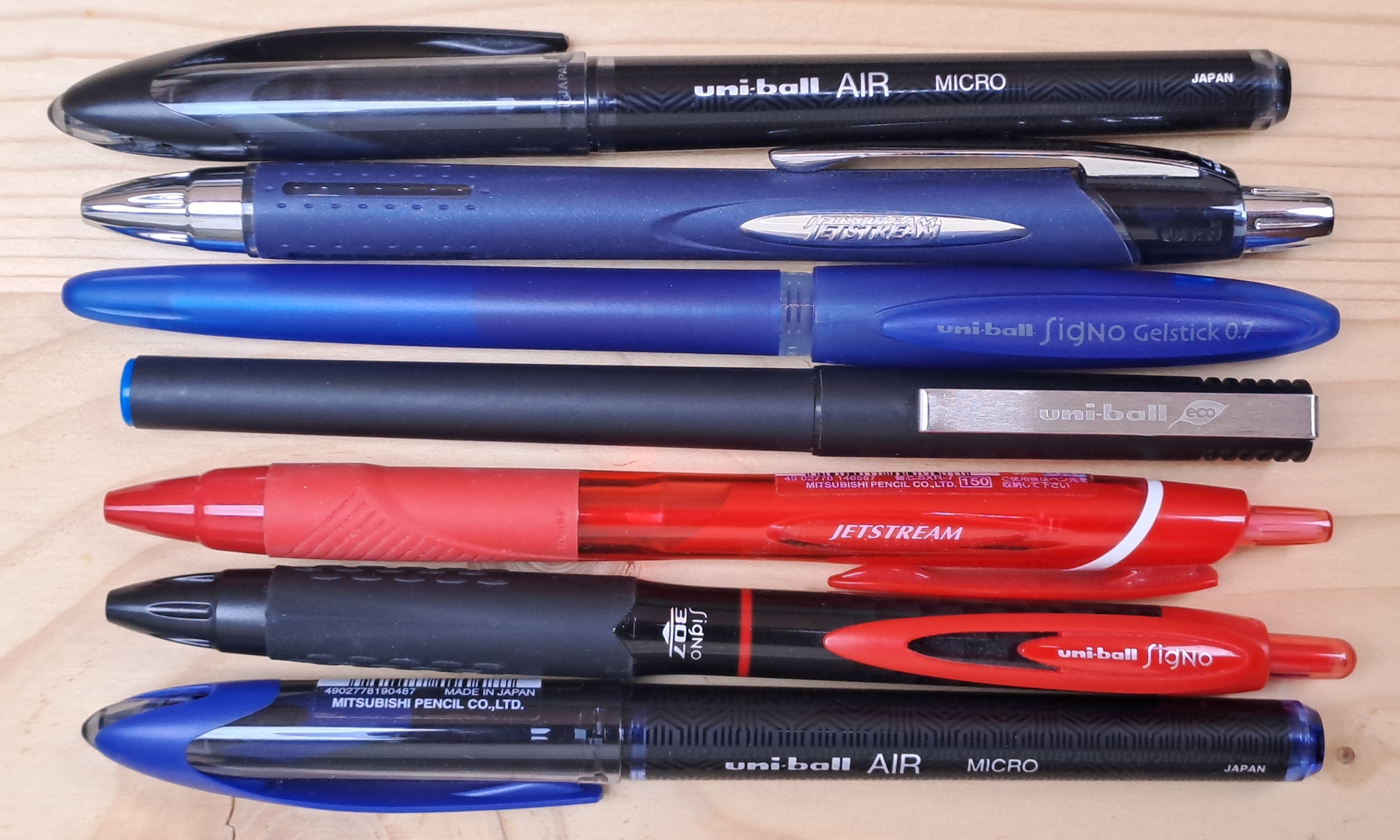
Before we get into the details, I’ll make a table with these pens, plus several rollerballs I’ve used in the past and that I’ll also use in the future (you guessed it, I have a few in my stash of writing implements):
| # | Type | Name | Code | Ball | Stroke | Refil | Notes |
|---|---|---|---|---|---|---|---|
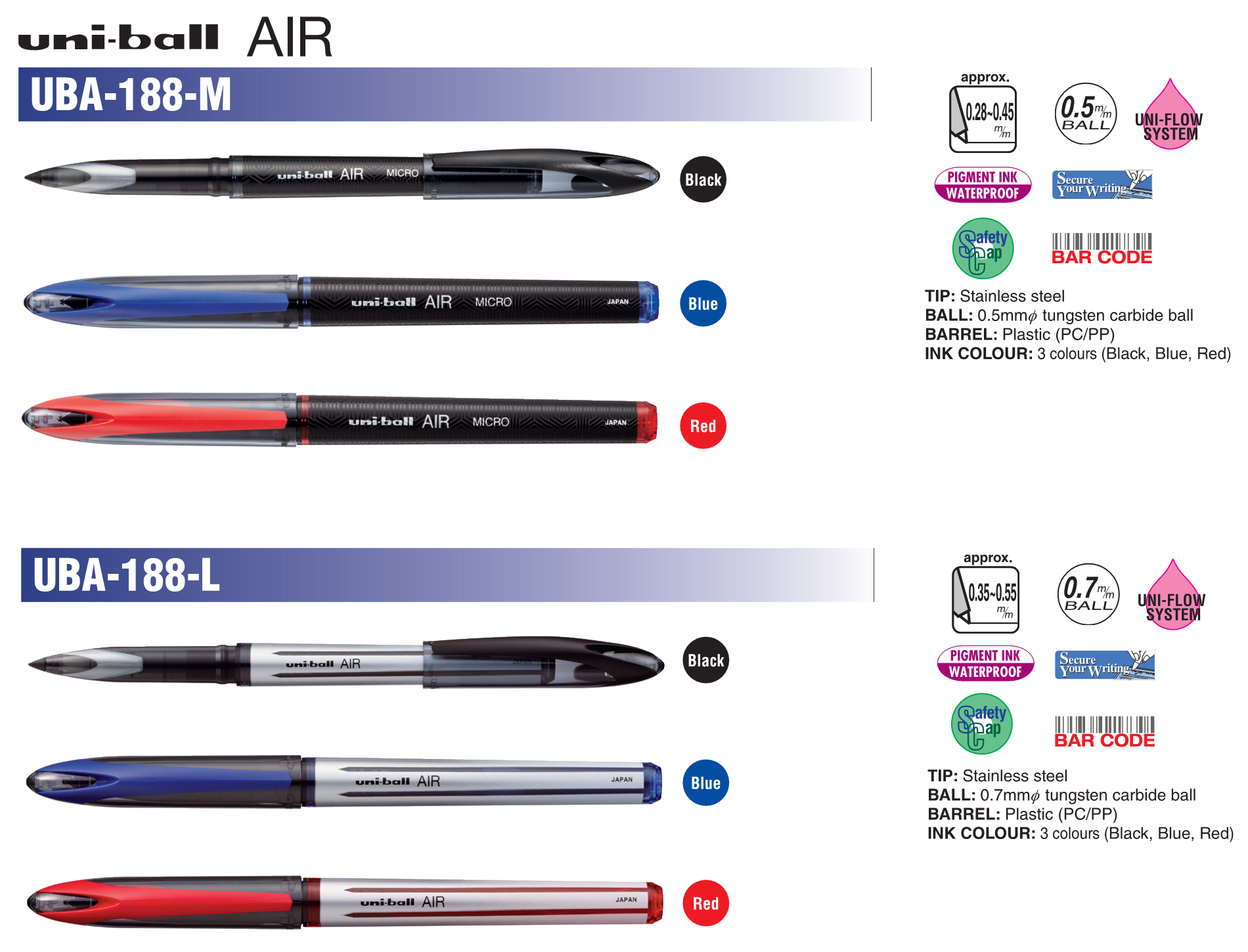
| 1 | Liquid ink | AIR MICRO | UBA-188-M | 0.5mm | 0.28–0.45mm | N/A | Great writing experience, but it can’t really write that finely. I’m a big fan of it nonetheless. |
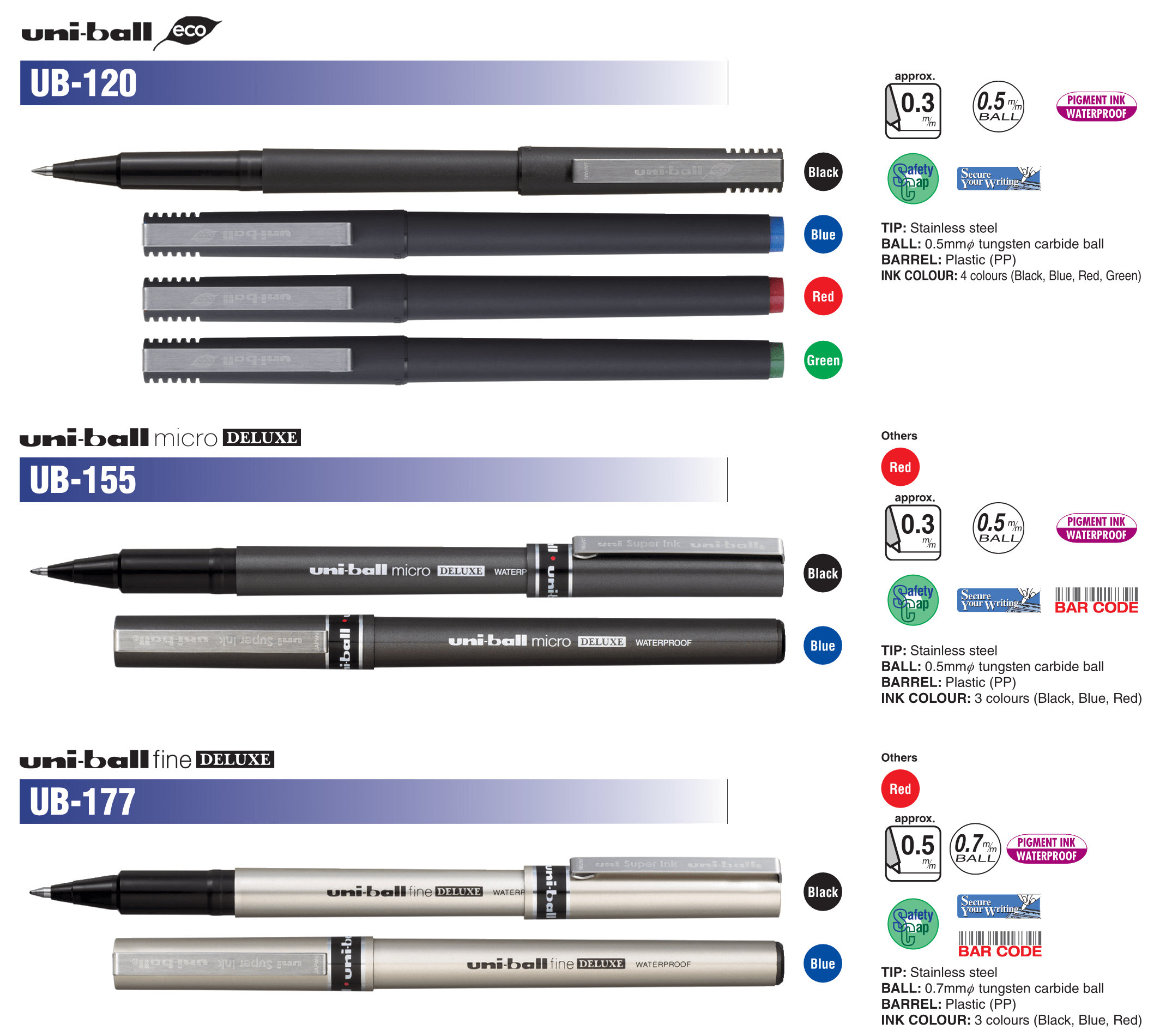
| 2 | Liquid ink | eco | UB-120 | 0.5mm | 0.3mm | N/A | Excellent for writing with fine strokes. |
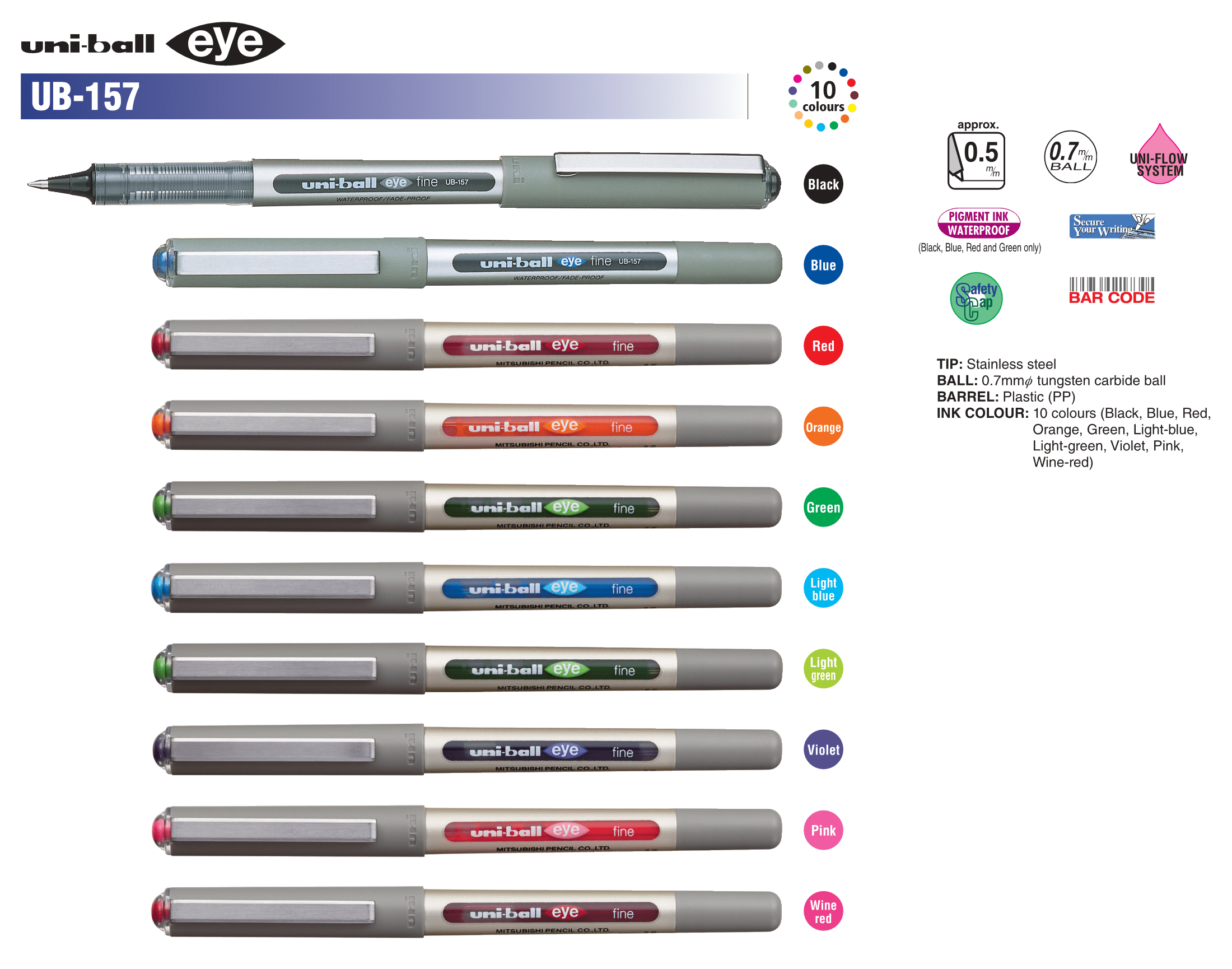
| 3 | Liquid ink | eye fine | UB-157 | 0.7mm | 0.5mm | N/A | Too thick stroke in practice. |
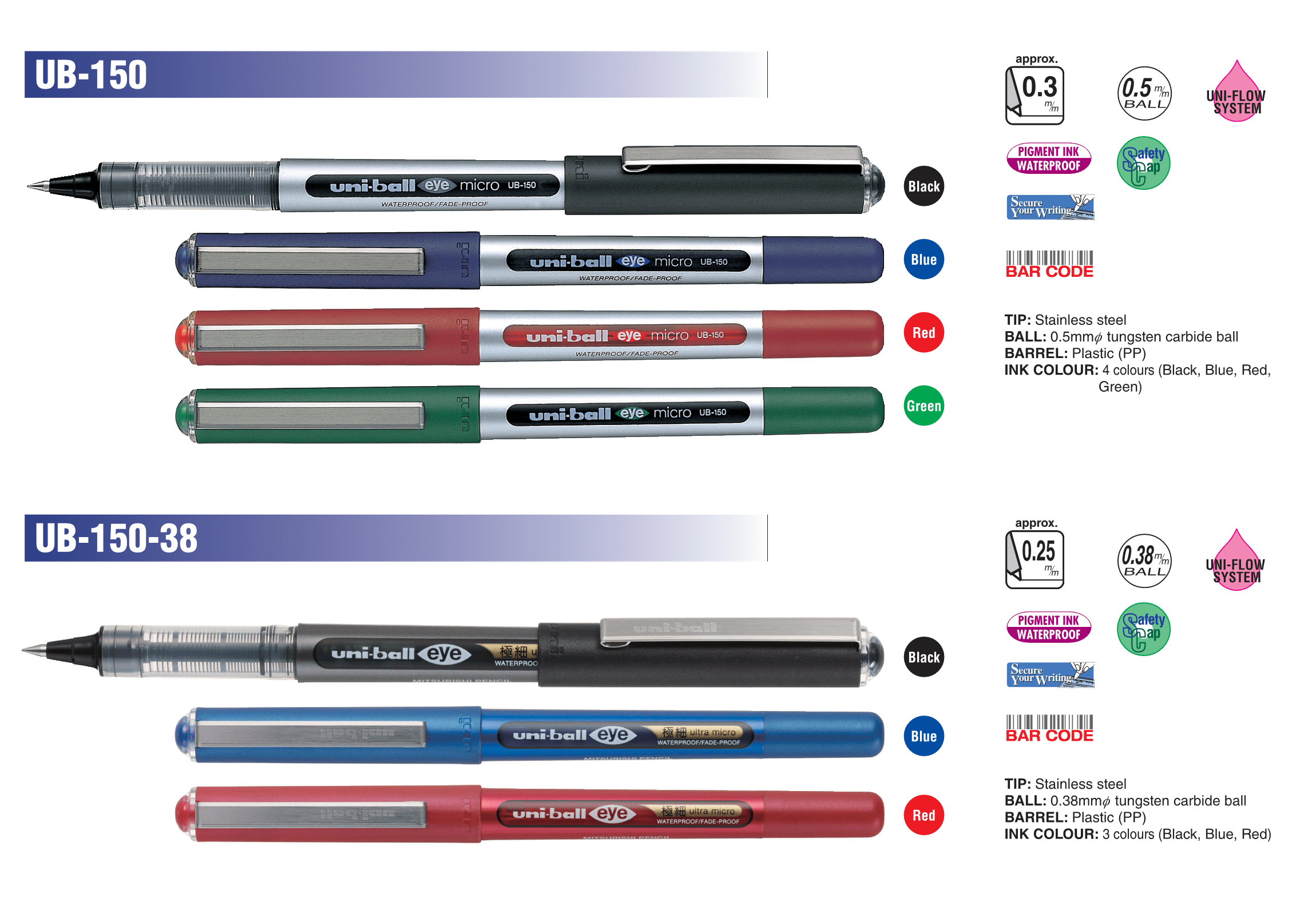
| 4 | Liquid ink | eye micro | UB-150 | 0.5mm | 0.3mm | N/A | Prefer the micro! |
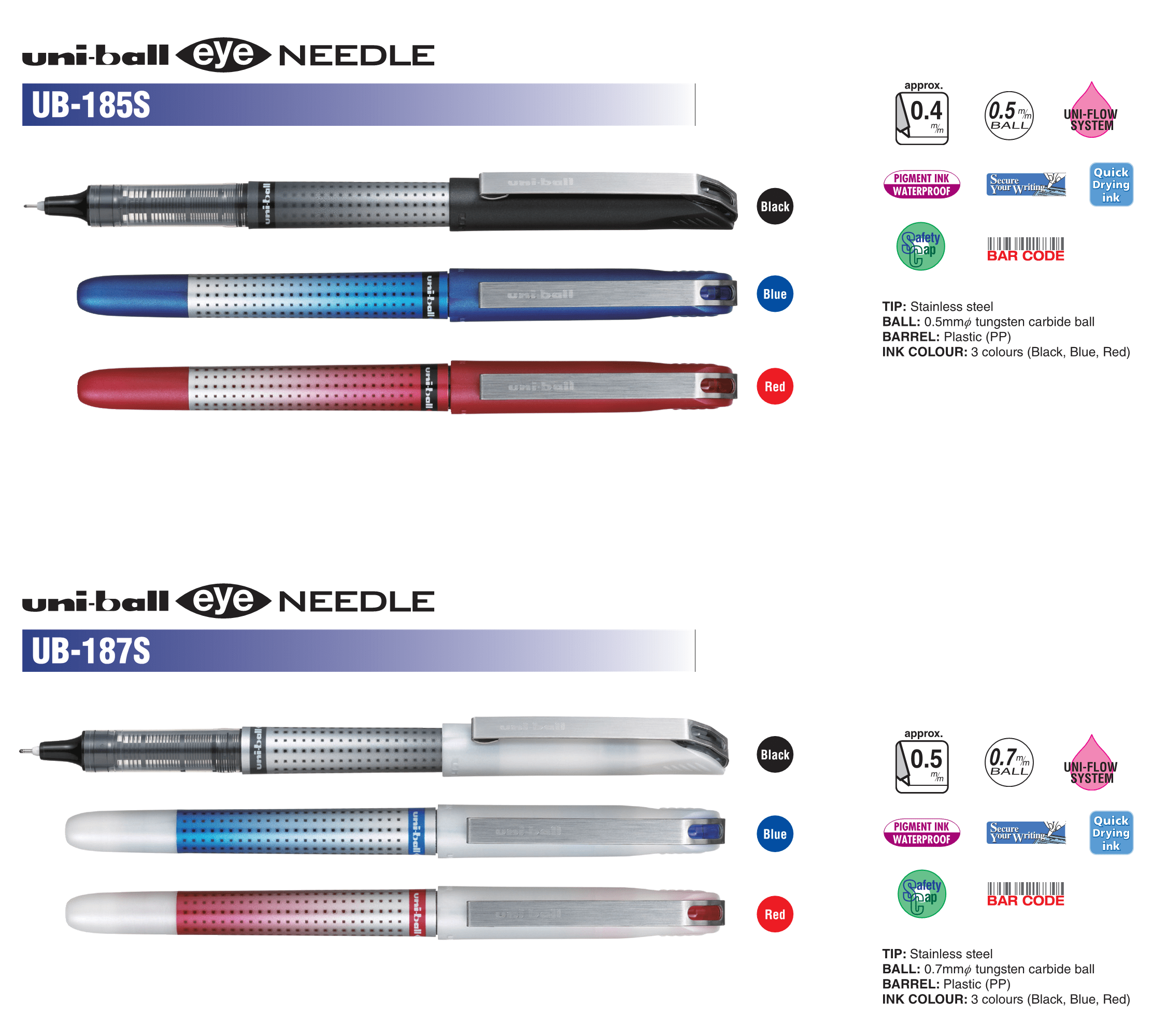
| 5 | Liquid ink | eye NEEDLE | UB-187S | 0.7mm | 0.5mm | N/A | The needle tip gives the feeling of precision, yet the writing isn’t that fine. |
| 6 | Liquid ink | eye NEEDLE | UB-185S | 0.5mm | 0.4mm | N/A | See above. |
| 7 | Liquid ink | VISION ELITE | UB-200 | 0.7mm | 0.5mm | N/A | Too thick. There is also a 0.8mm version that writes in 0.6mm. |
| 8 | Liquid ink | VISION ELITE | UB-205 | 0.5mm | 0.4mm | N/A | Prefer this one! The width is in the code, not in the name! |
| 9 | Gel ink | Signo Gelstick | UM-170 | 0.7mm | 0.4mm | N/A | The cheapest plastic with the greatest writing! |
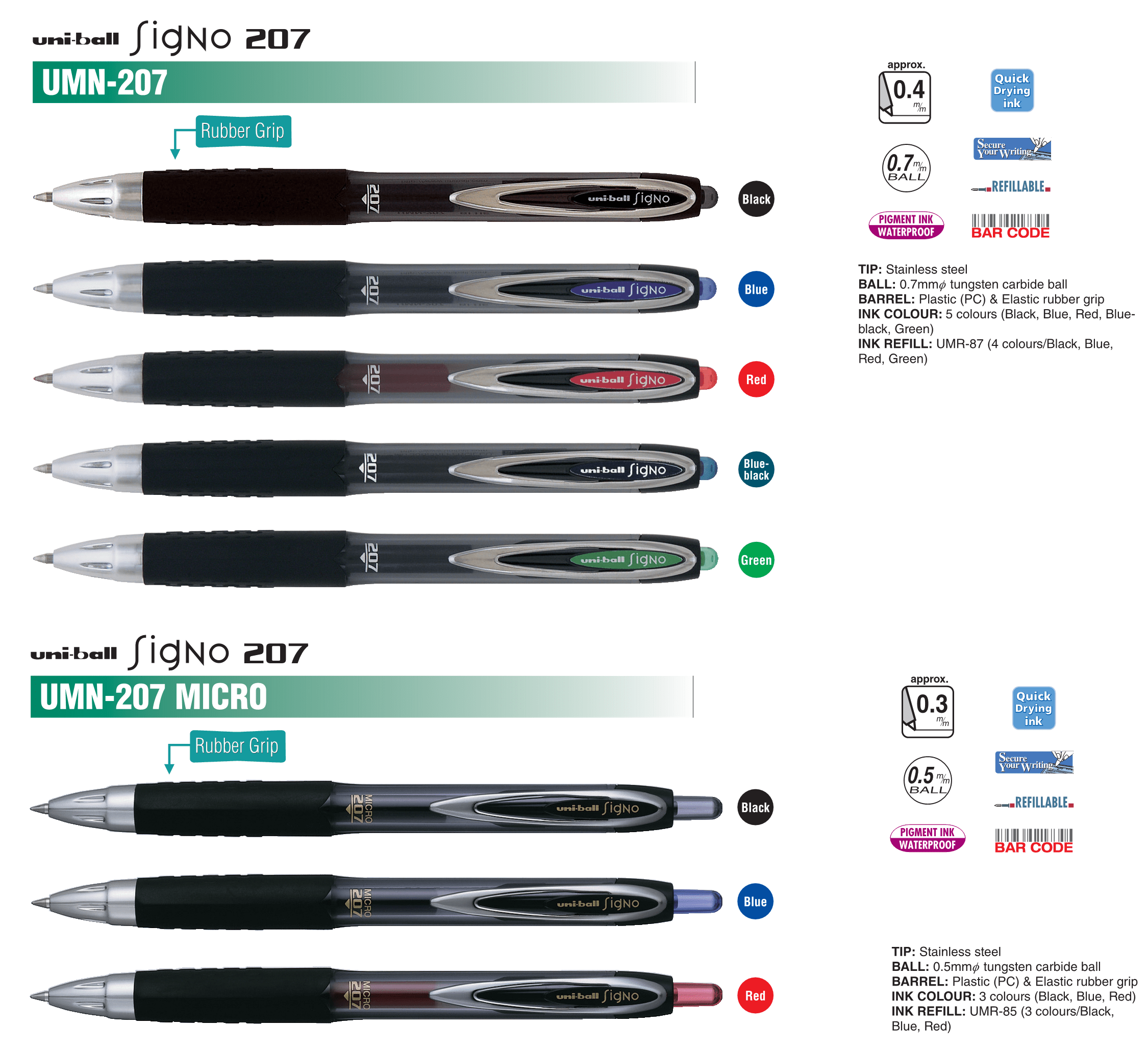
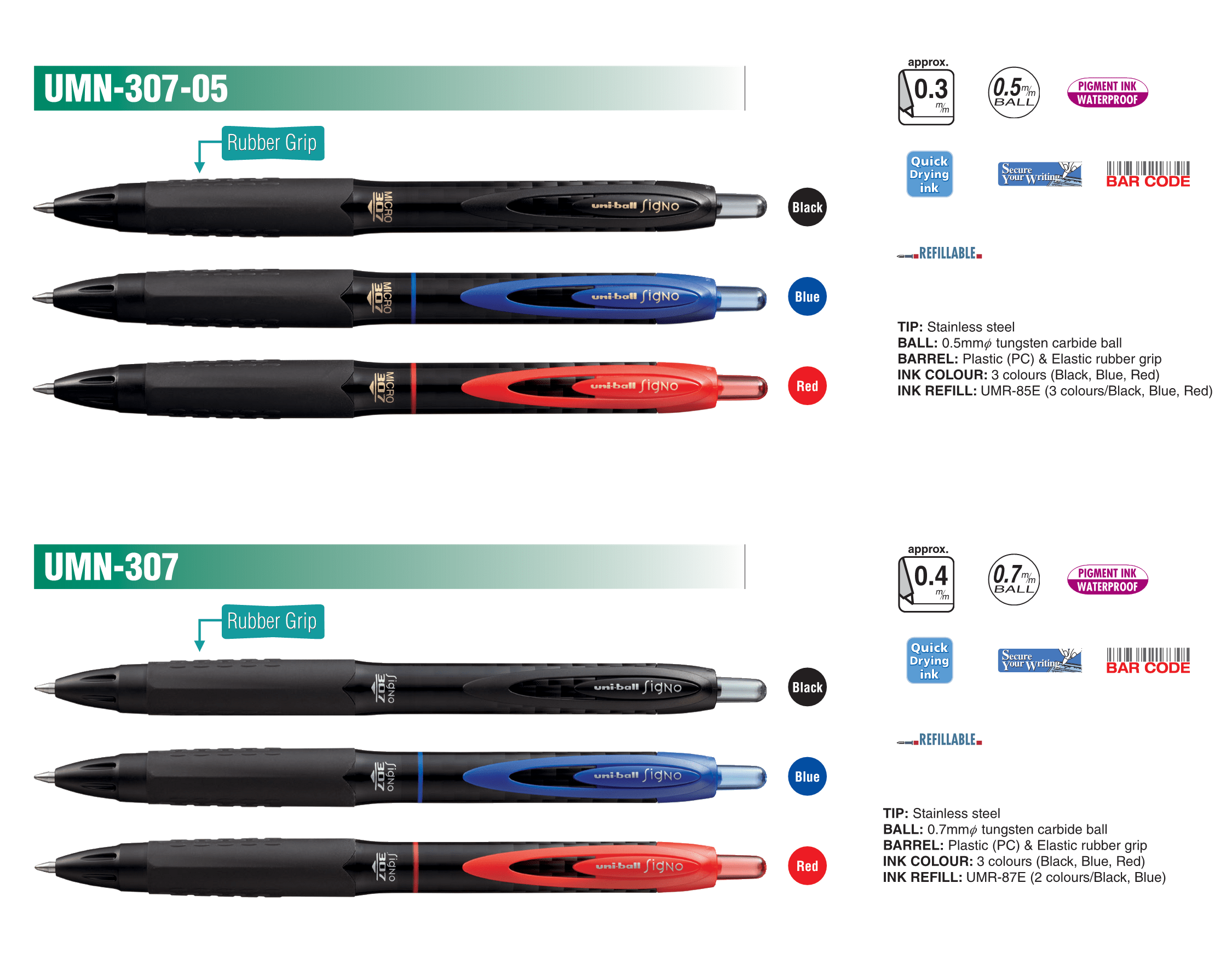
| 10 | Gel ink | Signo 307 | UMN-307 | 0.7mm | 0.4mm | UMR-87E | Premium build (the Signo 207 UMN-207 uses a different UMR-87 refill), great writing. I never tried the 0.5mm UMN-307-05 that writes in 0.3mm (equivalent to UMN-207 MICRO). |
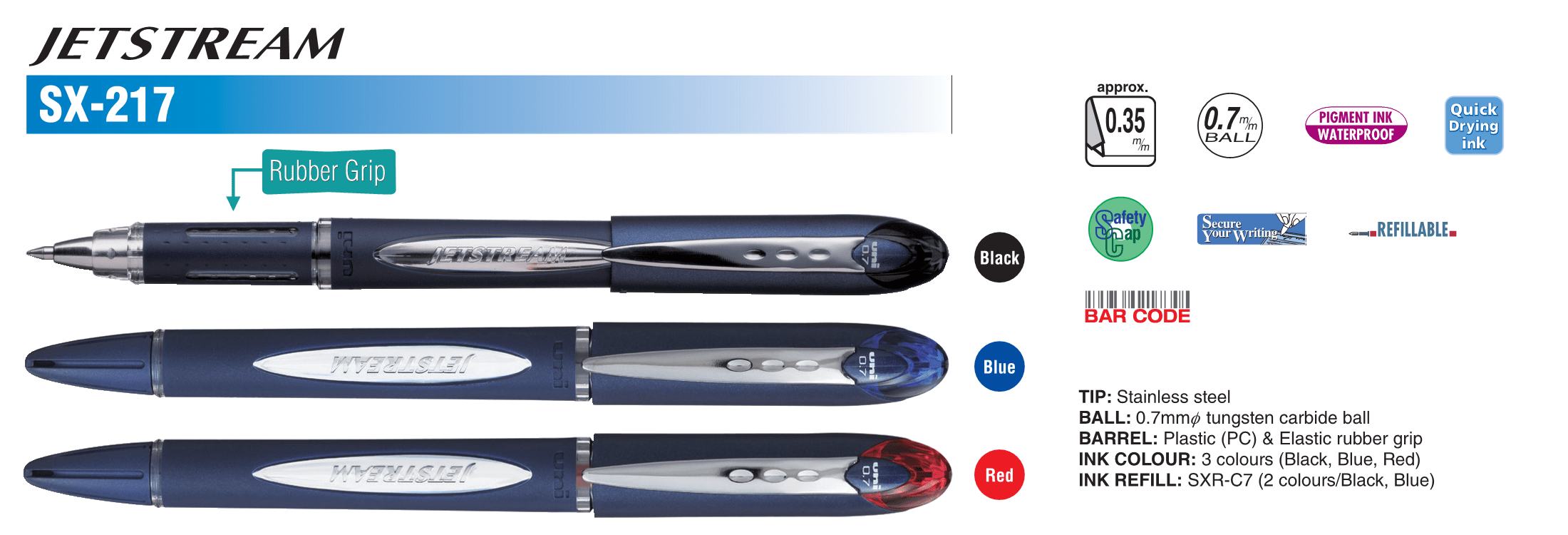
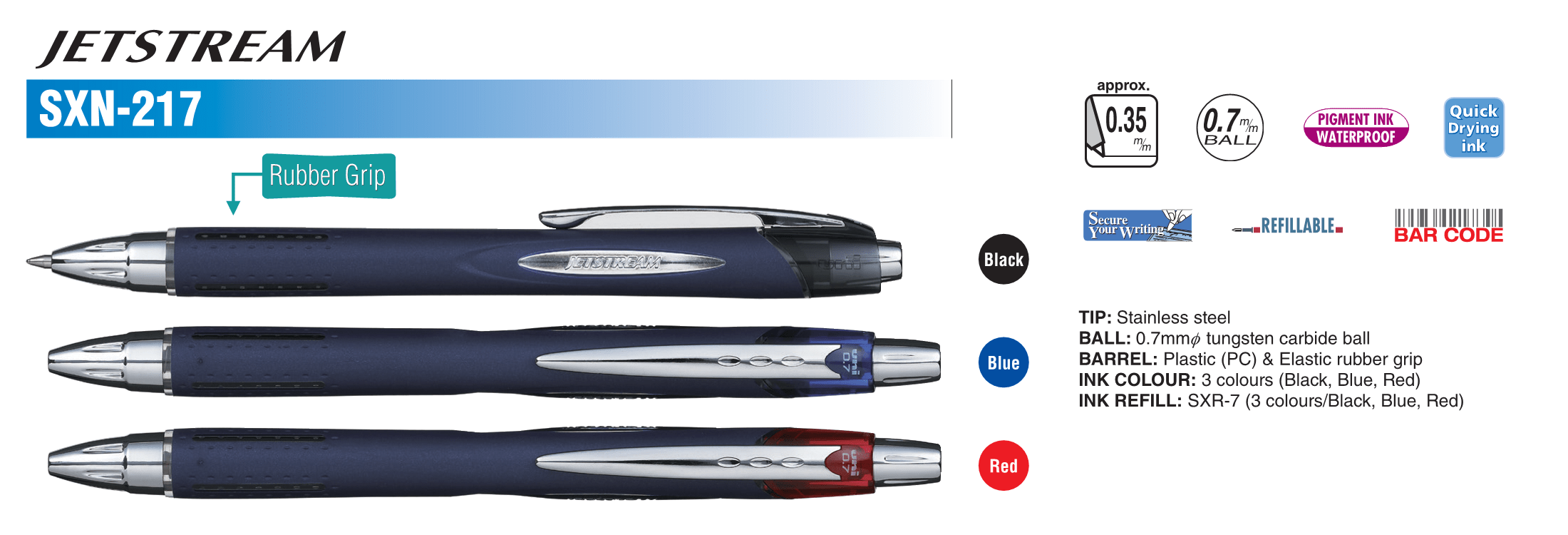
| 11 | Jetstream hybrid oil ink | Jetstream RT | SXN-217 | 0.7mm | 0.35mm | SXR-7 | Disappointing writing experience but yes, it has a fine stroke! The “RT” (retractable) has been dropped from the official name. The version with removable cap is SX-217. The 1.0mm models that write in 0.45 mm: SXN-210, SX-210. |
| 12 | Jetstream hybrid oil ink | Jetstream JP | SXN-150-07, SXN-150C-07 | 0.7mm | 0.35mm | SXR-7 | See above. Similar model: SXN-157S (“Sport”). Versions with codes ending in -10 and -05 have 1.0mm and 0.5mm balls and write in 0.45mm and 0.24mm. The “C” are available in 9 colors and made in the respective color. The “JP” in the catalog means “Manufactured in Japan from Japanese-made materials.” |
Based on the catalog for 2024-2025 (125 MB PDF, and the server is very slow), I’ll dig into the technologies behind these pens.
Note that I’ll only mention a subset from each category of pens. Generally, those that I used, with very few additions.
Jetstream—the gel that isn’t gel
Jetstream was my first contact with uni-ball. It happened in 2005. The mechanical part of their technology is sound, but the ink formula is a hit-and-miss in my opinion.
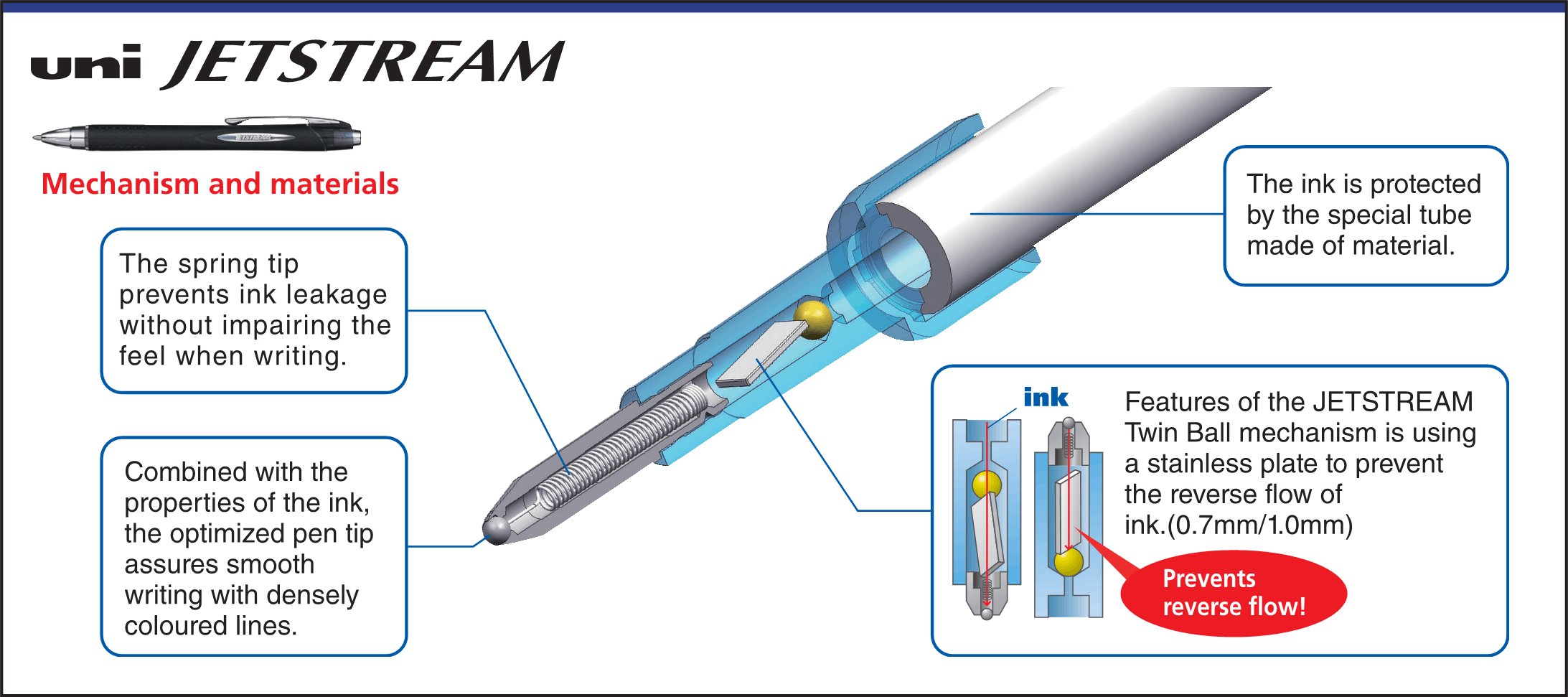
They don’t make any claim about Jetstream’s ink these days, but in the past they called it “hybrid ink.” Unfortunately, this “hybrid ink” is not water-based but oil-based; therefore, its viscosity still leads to some of the disadvantages of the classic ballpoint pen paste. In brief:
- The bad part: smudging can still happen.
- The good part: it writes with thinner strokes.
The classic capped and retractable versions with 0.7mm balls. Avoid the 1.0mm ones!
There are many more variations, many of them of little relevance and with questionable international availability.
I’d note the SXN-150-05 (0.5mm ball, 0.24mm stroke) and the SXN-150-38 (0.38mm ball, 0.19mm stroke) that I never encountered in person. What I did purchase was a red pen from the colored range:
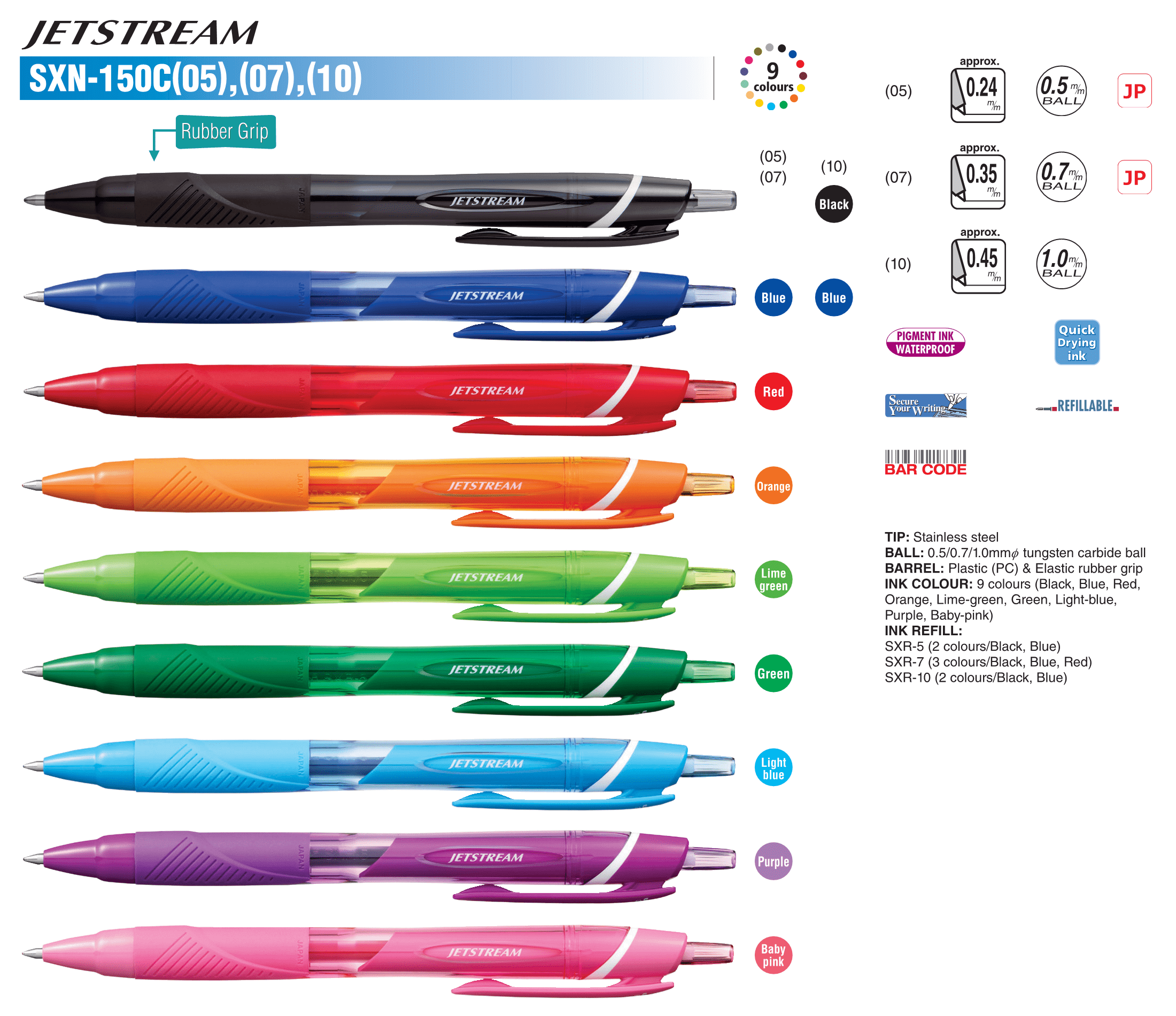
What bothers me is that they discontinued the 0.5mm of the classic capped Jetstream pen. I’m pretty sure this is what I purchased back in 2005 in the States. It might have had the code SX-215, unless they used a different notation back then.
Signo—the smooth gel
The Signo range is quite extensive these days, and its twin-ball mechanism is common to all models:
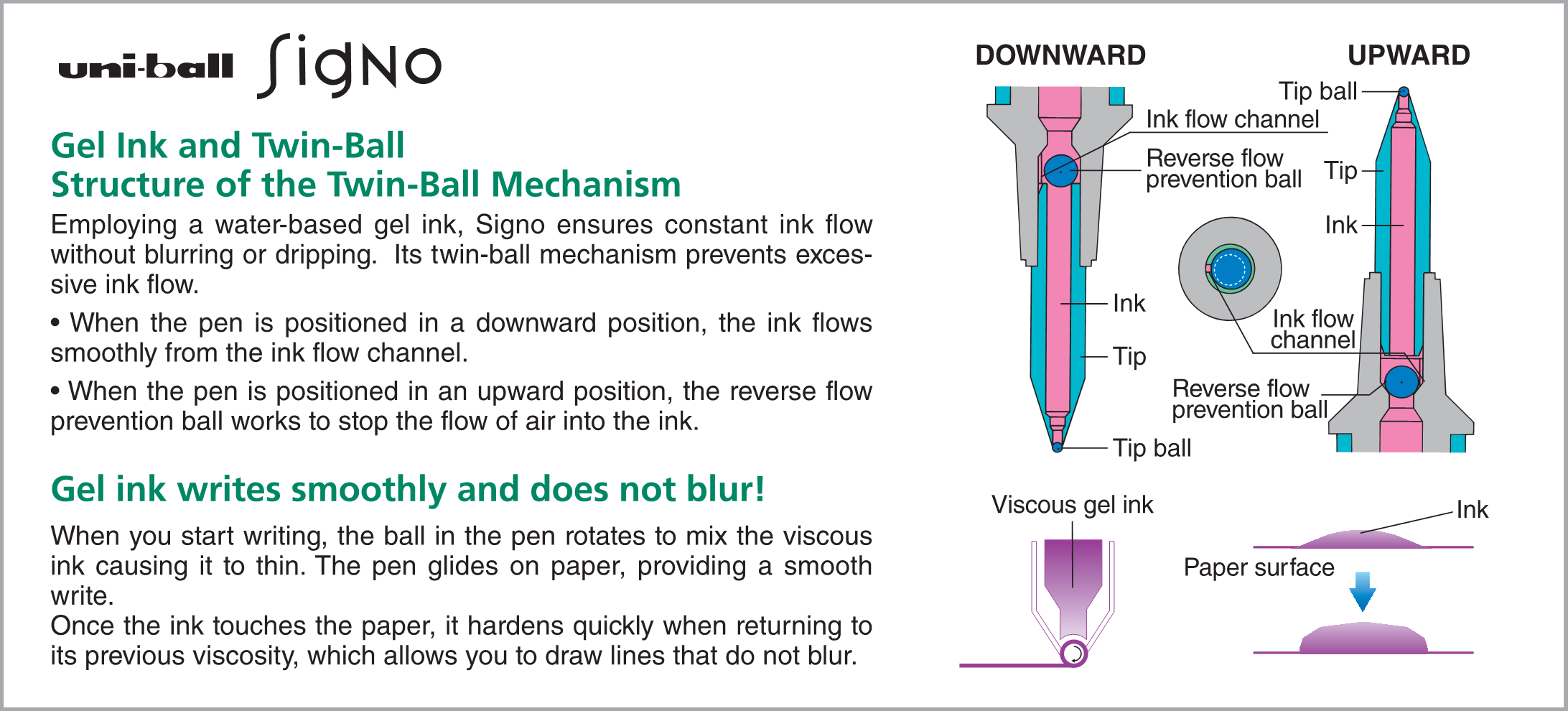
The Signo 207 has a long history behind it, and the newer Signo 307 claims to have added cellulose nano-fibers to the gel! From the 207/307 variations, the common models (the 0.7mm one is “standard” and the 0.5mm one is newer):
But the shocking one (again, the range is quite large!) is the cheapest and the least premium gel pen ever made by uni-ball: the Signo Gelstick 0.7:
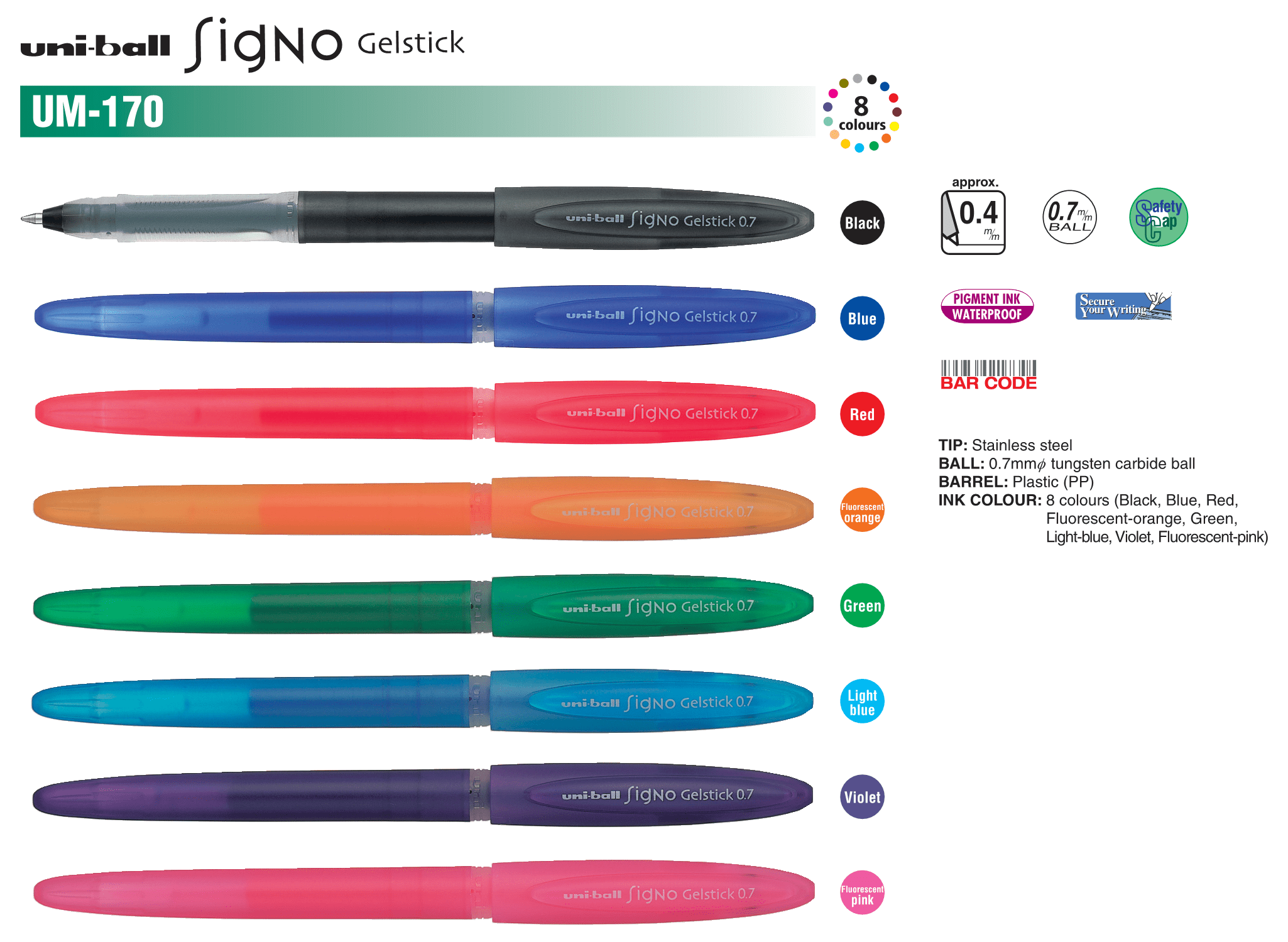
It feels bad when you struggle to remove the cap. The translucent part you hold it from when writing feels extra cheap because it is cheap plastic. And yet, the writing is great! €1.10-1.40 is a correct supermarket price.
AIR—their newest technology
I fell in love with uni-ball’s latest technology as soon as I purchased my first AIR MICRO pen! Liquid ink, baby! “Revolutionary Hybrid-Tip Technology,” they say.
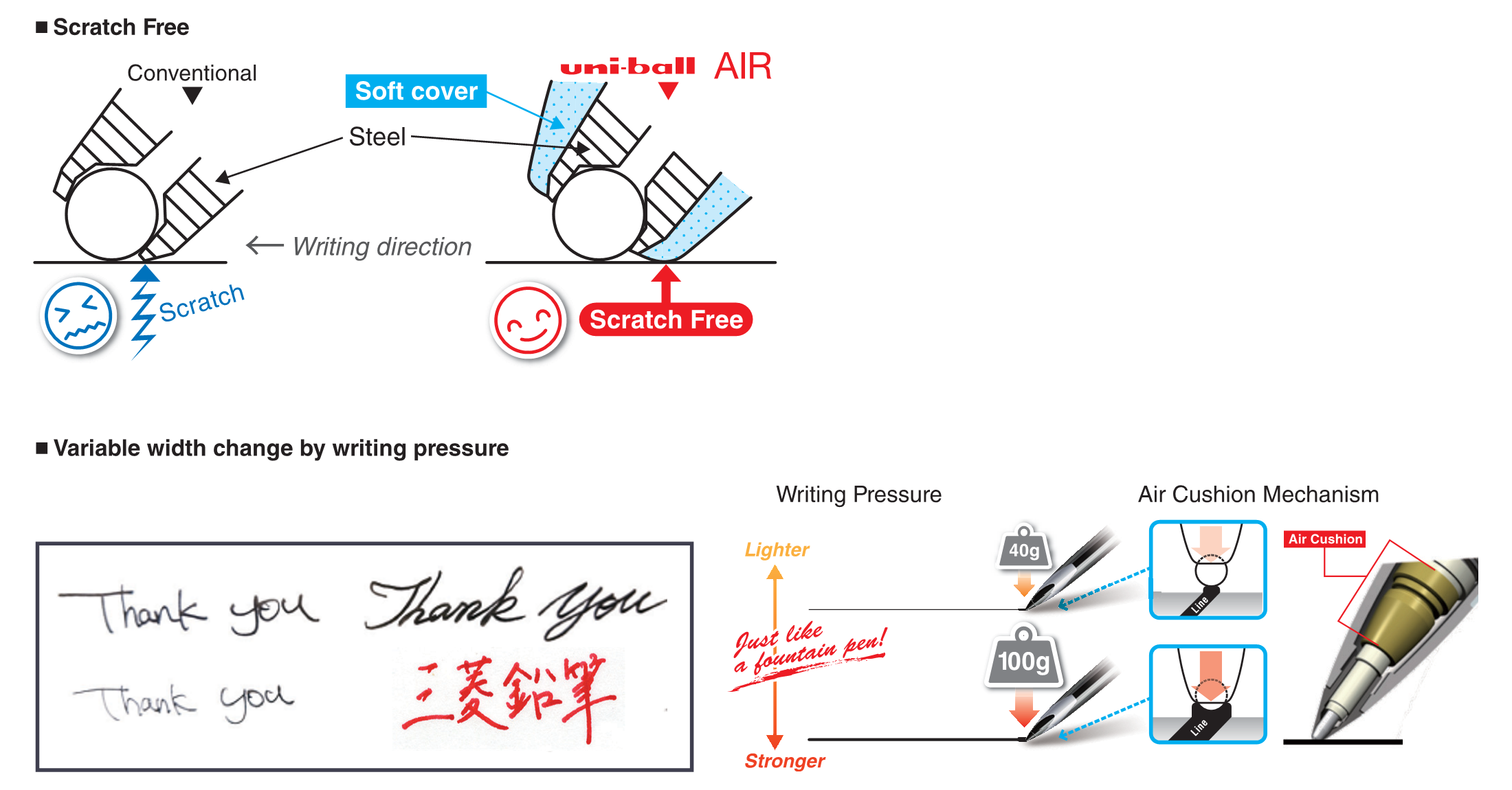
It’s not magic, but it feels great! Because it somehow writes almost like a fountain pen but thinner, it’s not suitable for the finest sketches, alright. But I always have one at hand! MICRO, mind you. I never tried the non-MICRO (0.7mm ball, 0.35–0.55mm stroke) variant, and I’m not sure that I should.
eco—with DELUXE siblings
That’s a very cheap one, but excellent when you need very fine strokes with liquid ink: the uni-ball eco UB-120 (0.5mm ball, 0.3mm stroke). It has some siblings with more “luxurious” casings and even 0.7mm balls, but only the eco is available with green ink:
eye—a classic rollerball
This is a more classic range of liquid ink rollerballs from uni-ball. They all write with wider lines than the official values for stroke width, especially if the paper tends to bleed the ink.
The eye fine in 0.7mm will write thicker than 0.5mm in my experience. The eye micro in 0.5mm is what I ended up purchasing, although the stroke is larger than the official 0.3mm. I should try the 0.38 mm eye ultra micro, should I find it. Maybe it would write in 0.25mm. Or maybe it’ll scratch the paper!
Discontinued liquid ink models
Somewhat similar to the eye line, there used to be a Grip line that I enjoyed years ago:
- uni-ball Grip micro (UB-245), 0.5mm ball
- uni-ball Grip fine (UB-247), 0.7mm ball
Why did they kill it?!
NEEDLE and VISION ELITE
By “needle,” they mean the tip is like a needle to help you have a better view of the exact point where it touches the paper. They are still rollerballs. If you hoped for a capillary tube with a genuinely hollow needle like the classic China/India ink technical drawing instruments from Rotring, you’d be wrong.
Similar to the eye range, the 0.5mm models should be preferred to their 0.7mm counterparts. The premium VISION ELITE comes with this claim: “For the Flying Business Person.” That’s because they’re supposed to be “airplane-safe” 🙂
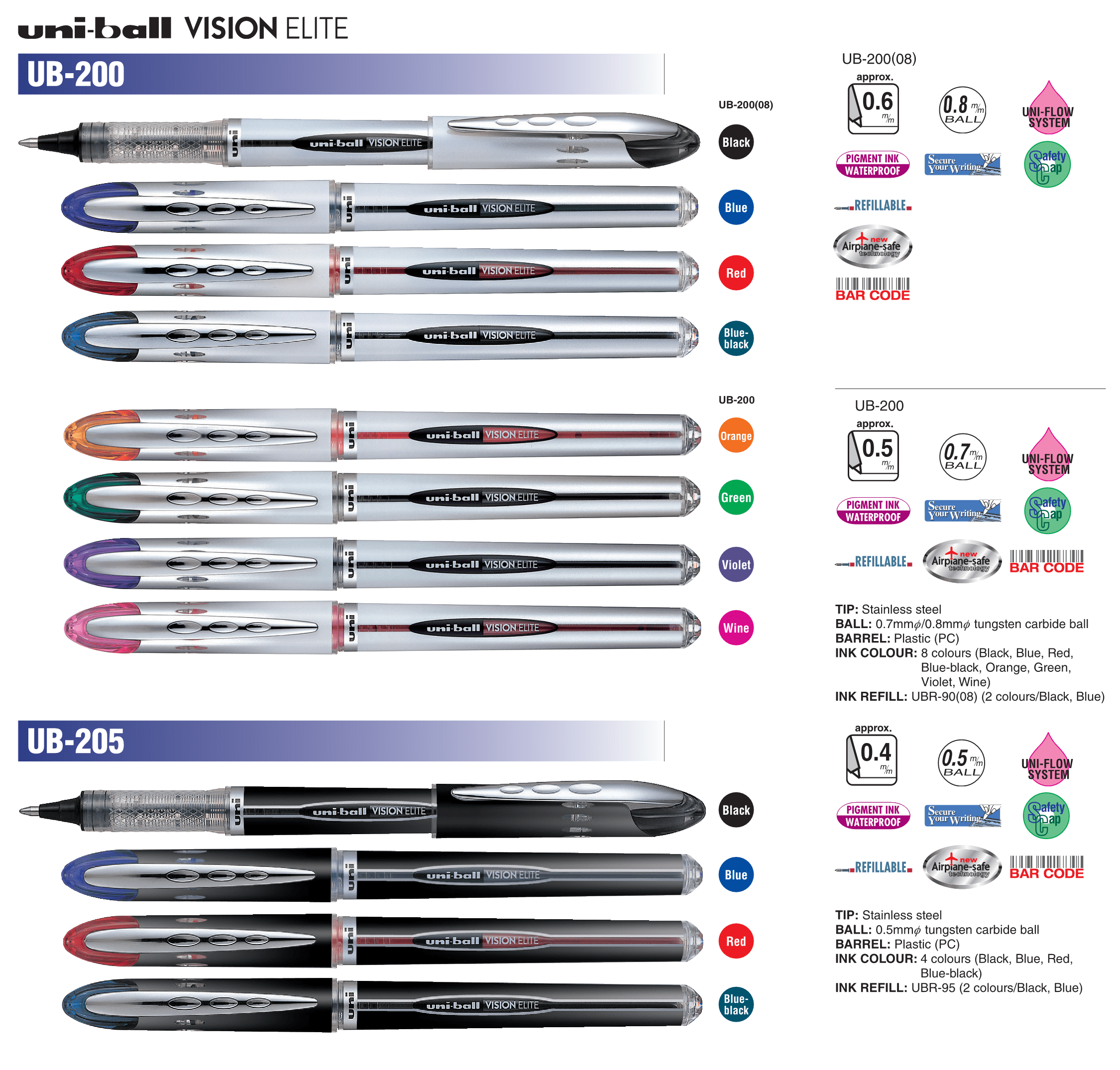
I never owned a UB-200 that comes in 0.7mm and 0.8mm, but I purchased a UB-205 pen that only comes in 0.5mm (0.4mm official stroke), and it wasn’t that bad. Yes, I tested it during a couple of flights!
Epilogue
I didn’t talk about fineliners. I didn’t discuss drawing instruments. Will I ever have the time to use the entire collection that I own? And no, they didn’t dry!
188 user-installed Android apps on my current smartphone. Windows and Linux computers. I’m not a complete Luddite. But what is life without paper? I’m not sure that I could use a Kindle Scribe, a reMarkable, or a Kobo Elipsa. A Luddite’s gotta draw the line somewhere.
Leave a Reply