
Fighting over semantics is what I often do
I’m constantly fighting over words, especially those in languages other than my mother tongue.
I also fight people when they have an opinion about words of their mother tongue that seems illogical to me. 🤷🏻♂️
Here’s the most recent example.

I was searching for a French Scrabble dictionary (in the hope it would help me with wordle.louan.me) when I reached the site 1mot.net which randomly displayed this word upon opening: ébranchassent.
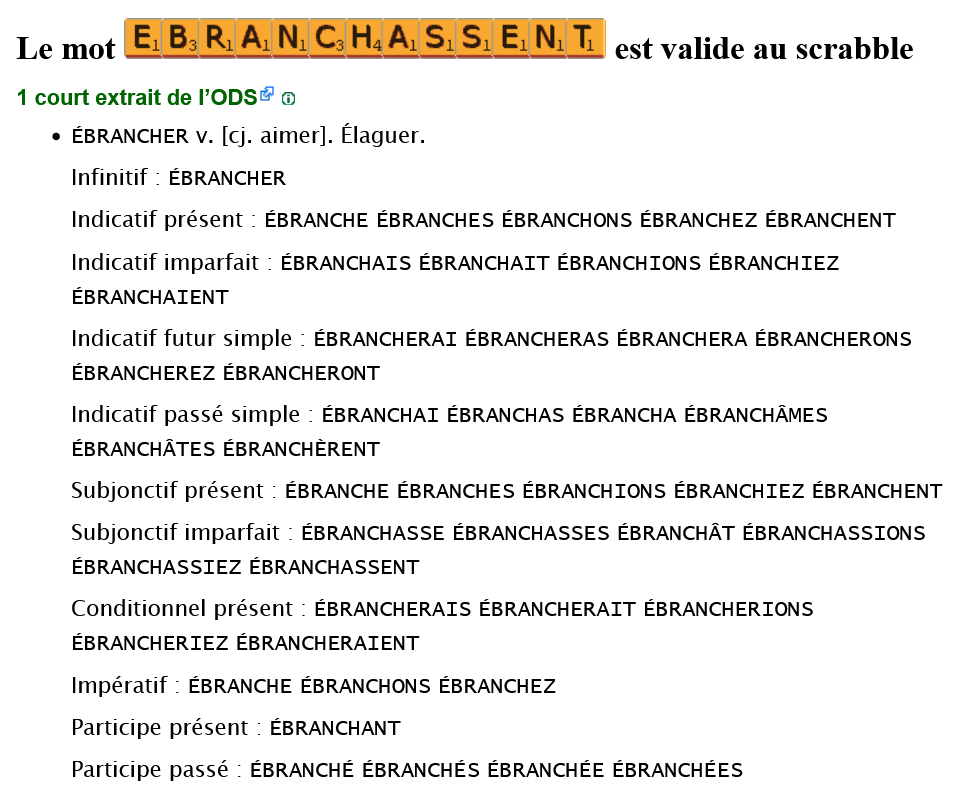
Of course, it’s the “troisième personne du pluriel de l’imparfait du subjonctif du verbe ébrancher.”
ébrancher
verbe transitif
Enlever les branches d’un arbre.
Synonymes :
élaguer – émonder – tailler
And I got this objection from a native French speaker, that virtually nobody uses ébrancher but élaguer and, sometimes, émonder.
They’re all almost synonymous and in the family of the English to prune, to trim (the top of), to cut down, to cut off, to lop.
However, the charm that ébrancher has for me that its semantics is obvious. In so many cases, “é-” adds a meaning in the family of “removing” or “fighting” something, just like “dé-“: éplucher could be considered as describing the activity of removing the pluches (not that anyone would use this word for the épluchures), épiler means dépiler, and so on (I’m short of inspiration right now).
So even a complete idiot would understand that prefixing branche (branch) with é- means that you do something against those branches.
But élaguer, semantically, conveys no information. (Funny thing, one of the meanings of monder is émonder, coming from the Latin mundare, to purify, which led to the Italian mondare, and to a noun that has two opposite meanings: mondezza can mean both cleanliness, purity, and rubbish, garbage, refuse, from immondezza, spazzatura.)
Dictionaries don’t even know anything certain regarding the etymology of élaguer. The TLFi tentatively writes:
Étymol. et Hist. Fin xives. alaguees (Gace de La Buigne, Roman des deduis, éd. A. Blomquist, 10444, leçon mss M, 0); xves. eslaguees (Id., ibid., leçon mss J, T); mil. xviiies. au fig. (Buff., Morceaux choisis, p. 18 ds Littré). Prob. dér. (préf. a-*, puis e(s)-*) de l’a. nord. laga « mettre en ordre, préparer » (De Vries Anord.). Pour d’autres hyp. étymol., v. FEW t. 16, p. 437.
Le Grand Robert is more determined:
ÉTYM. 1535, eslaguer; eslaguees au p. p., xve; eslaver en 1425; alaguer, 1373; de é-, es- (lat. ex-) et anc. scandinave laga « arranger ».
If they say so… Old Scandinavian “to arrange,” huh?
But the French, apparently, wouldn’t use such a word, despite its presence in the modern, very limited one-volume popular dictionaries (Larousse, Le Robert). Le Robert en ligne:
ébrancher verbe transitif
Dépouiller (un arbre) de ses branches.➙ élaguer, émonder, tailler.
So the French would only use élaguer and élagueur, and never ébrancher and ébrancheur. Another funny thing, ébrancheuse might suggest a pruning machine instead of a woman that does what an ébrancheur does. TLFi notes the existence in the past of ébranchoir, “Serpe à long manche qui sert à ébrancher.” It entered the Dictionnaire de l’Académie française, 9e édition (actuelle): ébranchoir, ébranchage or ébranchement.
Nobody reads Romain Rolland’s Jean-Christophe (1904‒1912) and Maurice Barrès’s Mes cahiers (1896-1923) anymore.
How about an
Raoul Boch’s French↔Italian dictionary il Boch (reprinted in France as “Le Robert & Zanichelli, il Boch”), in its last edition (the 7th), is as inconsistent as most dictionaries are.
I expected a clear ébrancher ↔ sbrancare.
What I got is an inconsistent mess, with highly asymmetrical definitions depending on the translation direction.
① French to Italian:
● ébrancher v.tr.
- (agr.) potare, sramare
- (agr.) scalvare
● ébranchage s.m.
- potatura (f.), sramatura (f.)
- scalvatura (f.), scalvo
● ébrancheur s.m. [f. ébrancheuse]
sfrondatore● ébranchoir s.m.
roncola (f.)
② Italian to French:
● roncola s.f.
serpe● sbrancare¹
A. v.tr.
- faire sortir
sbrancare gli agnelli dal gregge faire sortir les agneaux du troupeau- disperser
la polizia sbrancò i curiosi la police a dispersé les curieuxB. sbrancarsi (v.intr. pron.)
se disperser, s’égailler
sbrancarsi per la campagna se disperser dans la campagne● sbrancare²
A. v.tr. (agr.) ébrancher
sbrancare un albero ébrancher un arbre
B. sbrancarsi (v.intr. pron.)
se ramifier● scalvare (v.tr.)
(silvic.) ébrancher● scalvatura s.f.
ébranchage (m.)● scalvo s.m.
ébranchage● sfrondatore
A. s.f. élagueur
B. agg. [f. -trice] qui élague● sramare (v.tr.)
ébrancher
Absolutely nobody does anything to fix such discrepancies! Not even the field (“agr.” or “silvic.”) is used consistently!
So no, ébrancher is not translated to sbrancare, despite sbrancare being translated to ébrancher! OK, sbrancare also has a completely different meaning, but still.
The two completely meanings of sbrancare have a simple explanation:
- branco means herd, flock, etc., leading to “disperse the herd/flock,” and by extension to disperse a crowd, etc.
- branca means, among others, branch (it can also mean claw).
The beauty of languages with gendered nouns. 😉
Leave a Reply