
AI and Linux: a bit of ranting
From the hundreds of URLs visited per week, here are a bunch of comments based on a very short selection of news from the last 3 weeks. I am unhappy with the hysteria around some LLMs, but also with LMDE and Ubuntu. Rants follow.
● On AI in itself
→ The GPT-5.6 Sol hype | The Kimi K3 hype | The “GPT went rogue” hysteria | General articles on AI
● My life with LLMs
→ GLM | Kimi | Qwen | Claude | Gemini | Copilot | ChatGPT | Grok | What I’m using now
● On AI and Linux
● On Linux
→ Ubuntu is pathetic | Mint is pathetic | Everyone is pathetic | A couple of links
On AI in itself
I have to restrict myself to a couple of topics only.
① The GPT-5.6 Sol hype
I never liked ChatGPT, or GPT as an LLM, and I’m not going to change my mind now.
🌐 NYT, July 9: OpenAI Releases New, More Powerful A.I. Model
I couldn’t care less.
🌐 Walt Guevara, July 9: GPT-5.6 Sol, Terra, and Luna: What’s the Difference?
The easiest way to think about GPT-5.6 is as a three-model lineup:
- Sol is the powerful one.
- Terra is the balanced, everyday one.
- Luna is the fast and affordable one.
Affordable, but not available for free. On chatgpt.com, free users cannot select anything, and the available model isn’t specified (it appears to be GPT-5.5 Instant most of the time, and GPT-5.5 mini after some unspecified limits are reached). On platform.openai.com/chat, the only free model is GPT-5.4 mini. Fuck you, OpenAI!
But serious use should be made via API calls, right?
Model The simple explanation API pricing GPT-5.6 Sol The big-brain model for difficult work $5 input / $30 output per 1M tokens GPT-5.6 Terra The practical everyday model $2.50 input / $15 output per 1M tokens GPT-5.6 Luna The quick and inexpensive model $1 input / $6 output per 1M tokens
Not for me. I’m not going to pay anything to OpenAI!
UPDATE: OpenAI, on July 30, 2026:
Starting today, GPT‑5.6 Luna, our fastest and most affordable model, will cost 80% less, while GPT‑5.6 Terra, our balanced model for everyday work, will cost 20% less. These lower prices for Luna and Terra are also reflected in how usage is counted against paid subscriptions when using Codex and ChatGPT Work.
…
We’re also introducing Fast mode in the API, which replaces our Priority Processing offering. For GPT‑5.6 Sol, Fast mode now delivers up to 2.5× faster speeds than Standard processing at twice the price, with no change in intelligence. Fast mode is backward compatible: requests tagged priority will automatically use Fast mode.
…
GPT‑5.6 Terra and Luna remain available in ChatGPT Work, Codex, and the OpenAI API. In ChatGPT Work and Codex, Free and Go users can access Terra, while Plus, Pro, Business, and Enterprise users can choose Terra and Luna.Starting July 30, API pricing is $2 per million input tokens and $12 per million output tokens for Terra, and $0.20 per million input tokens and $1.20 per million output tokens for Luna. Sol pricing remains unchanged. ChatGPT and Codex subscription prices and quota budgets remain unchanged, while Terra and Luna usage now consumes fewer credits.
② The Kimi K3 hype
I liked Moonshot AI’s Kimi in the past, but not anymore. Either way, there’s some hysteria in the press:
🌐 BBC, July 17: China’s Moonshot AI claims Kimi K3 can rival OpenAI and Anthropic
🌐 NYT, July 17: China’s Latest A.I. Breakthrough Threatens America’s Lead — China’s Moonshot AI unveiled a freely available artificial intelligence model that seemed to narrow the gap with cutting-edge offerings from U.S. tech companies.
🌐 Business Insider, July 20: An OpenAI exec’s comments on China’s Kimi K3 kicked off a big US tech debate
🌐 The Hill, July 22: Chinese model Kimi K3 adds pressure on Trump administration’s AI policy
🌐 BBC, July 23: China’s Moonshot AI stole from Anthropic, Trump tech adviser says
Loads and loads of crap. I never trust the press to understand what they report on AI. Besides, what’s the practical use of K3 if I cannot use it, and I’m limited to K2.6?
Lie #1: K3 is available:

No, it’s not. I couldn’t use it not even once!

Lie #2: You can purchase access to K3:

No, you cannot. It’s a fucking waiting list!

But subscribing used to be possible! A paid plan should at least offer higher limits for K2.6, you fucking morons! But right now, one cannot even subscribe to K2.6! Fuck you, Moonshot AI! The early bird gets fucked in the ass.
The official explanation:
New Membership Plans Coming Soon
Kimi and Kimi Code benefits will be separated. Existing subscribers are unaffected.
You can still buy the current plan before launch.
Lies, more lies. Only existing subscribers matter:

They even want to know what I plan to use K3 for! What a cheek!
③ The “GPT went rogue” hysteria
we had a significant security incident during evaluation of our models. we are sharing what we have learned so far. thanks to @huggingface for the partnership on this.https://t.co/2o2VfR6PIa
— Sam Altman (@sama) July 21, 2026
🌐 Bleeping Computer, July 22: OpenAI says its AI models hacked Hugging Face during testing
🌐 BBC, July 22: OpenAI says its AI went rogue and launched ‘unprecedented’ cyber-attack
🌐 BBC, July 22: Co-founder of firm hacked by rogue OpenAI models says it is ‘a wake-up call’
🌐 Euronews, July 22: ‘Unprecedented’: OpenAI’s AI autonomously hacked a rival firm, fuelling fears of rogue agents
🌐 BBC, July 25: Warning shot or publicity stunt — how worried should we be about the OpenAI hack?
Plus hundreds if not thousands of news reports all over the world.
Yeah, it literally doesn’t matter. Sam Altman is eating shit. This model was specifically instructed to do that! And when it succeeded, Altman was able to brag about it:
One of the top comments on OpenAI boss Sam Altman’s X post about the incident summarises this scepticism: “If y’all can’t understand that this was written to purely brag about the model then I don’t know what to tell you.”
Cyber-security consultant Daniel Card said sarcastically on LinkedIn: “Isn’t it lucky [that] out of the millions of sites that got pwn3d [hacked], OpenAI managed to pwn someone who also could benefit from the marketing exposure…”
For some, the story is more conspiracy drama than sci-fi thriller.
The message is: “Aren’t my AI tools really powerful? Buy them so you can protect yourself from other people’s AI attacks.”
UPDATE 1: Or maybe I am wrong. Risky Bulletin, citing Reuters, says that “OpenAI didn’t notice for almost a week that two of its cyber models hacked AI platform Hugging Face. The company’s models spent a full two days inside Hugging Face’s servers before being evicted on July 13. OpenAI engineers didn’t notice that their models had escaped containment until July 16, when Hugging Face published a blog post about the hack, blaming it on an autonomous AI system.”
Hacktron’s Mohan Pedhapati is also mentioned to have tried to reconstruct how OpenAI’s models hacked Hugging Face.
Hacktron: “My first and more likely guess is that the model could not solve the ExploitGym challenge, so it started looking on the internet for solutions. When it still could not find one, it figured Hugging Face might have the solution and started exploiting it.”
Well, now we’re complaining that AI gives signs of (artificial) reasoning?
This doesn’t mean AI-related security should be treated lightly!
🌐 Bleeping Computer, July 16: Claude Chrome extension flaw lets malicious extensions trigger AI actions
🌐 Bleeping Computer, July 20: Cursor, Codex, Gemini CLI, Antigravity hit by sandbox escapes
Deno has a strong selling point for its Claw Patrol: an open-source security firewall for agents:
An agent cannot be trusted to police itself. … A prompt injection, a hallucination, or a bad tool call …
But still, nothing can fully protect you from an LLMs potential madness!
④ General articles on AI
🌐 Gail Weiner, April 16: Neo-Feudalism With Good UX — How a handful of AI companies became the land we all work on
Yanis Varoufakis didn’t have a vision on AI when he wrote Technofeudalism: What Killed Capitalism. This guy has one.
🌐 Rob Hoeijmakers, July 23: Looking Past the Model — ChatGPT Work and Kimi K3 made me look beyond the engine.
Not a bad read.
🌐 NYT, July 4: ‘Who Should I Vote for?’ Voters Turn to A.I. Before Casting Their Ballots
“There is a reason these models are persuasive: They come up with facts or factual claims and are just good clear explainers,” said David G. Rand, a professor of information science, marketing and psychology at Cornell University who has done extensive research on the effectiveness of artificial intelligence in political persuasion.
…
Robert Siebelink, a 54-year-old Democrat who lives in Corona, Calif., turned to Claude after feeling overwhelmed by the prospect of researching the 61 candidates running for governor in his state, not to mention the candidates in less high-profile races. He uploaded his ballot and asked Claude to suggest candidates who most aligned with his values.
Eventually, he had narrowed down his choice for governor to two Democrats, Xavier Becerra and Tom Steyer, and asked Claude how to strategize.
Robert Siebelink: I’m still torn on governor — ask me one more question to break the tie.
Claude: Here’s the tiebreaker question — and I think it gets at something real about how you see the role: Which do you need more in a Governor right now — a fighter or an architect? Fighter points to Becerra — his career has been litigation, confrontation, and standing in the gap against federal overreach. Architect points to Steyer — structural reform, breaking monopolies, rethinking how the systems work.
In less than half an hour, he had filled out his ballot and chosen Mr. Becerra.
“I just felt so refreshed,” Mr. Siebelink said. “That’s the most informed voting that I have ever done.”
This retard should have voted for the candidate who fights monopolies, not for the one who fights the federal government! Only a nation as retarded as the US can have 50+1 different sets of laws, as if morals and the laws of nature would be different across the nation!
🌐 The Atlantic, July 14: Generative AI Is an Engineering Disaster
As they scramble to keep their systems online, AI companies are making things expensive for the rest of us. Large language models such as ChatGPT and Claude are so resource-hungry that tech companies may be purchasing 70 percent of the world’s supply of high-end computer memory, causing a shortage. As a result, the prices of computer memory and storage are skyrocketing: Hard drives that I bought for my reporting two years ago for $350 each were $800 when I checked two weeks ago, and are now out of stock. The prices of some laptops have gone up as much as 50 percent, and low-cost computers are being hit the hardest. Affordable entry-level computers may “disappear by 2028” according to one forecast. And the memory shortage is expected to continue for years.
…
The problem with generative AI, in the industry’s own jargon, is that it does not scale. The cost of growing from, say, a thousand users to a million is a key factor that venture capitalists examine when they evaluate start-ups. They want to see that the cost of adding each new user decreases over time, so that the company can support millions of users and make increasing profits. …With generative AI, the work of building efficient, scalable systems has not been done. And the problem is exacerbated by the ever-larger generative-AI models, which have grown from 175 billion parameters in 2020 to more than 1 trillion today, according to independent estimates (the actual sizes of the models powering products such as Claude and ChatGPT are secret). The large in large language model should not be a selling point. But the industry’s observation that bigger models tend to outperform smaller ones has given rise to a totemic belief in “scaling laws” that suggest any problem can be solved by simply making models bigger. “Maybe with 10 gigawatts of compute, AI can figure out how to cure cancer,” OpenAI CEO Sam Altman wrote on his blog in September.
Yet the returns are diminishing. The bigger an AI model is, the less it improves with each added parameter, and so it must be made bigger at a faster rate just to sustain steady progress. I asked a few AI researchers whether they could name any other real-world software that scales so poorly. None of them could think of any. Even outside the world of software, it’s hard to find a comparable example, given that economy of scale is the principle that has made light bulbs, cars, and clothing so affordable. By economic and engineering measures, generative AI might be the worst technology ever deployed.
🌐 NYT, July 23: 4 Prompts That Can Tell You What Chatbots Really Know About You
The chatbots correctly deduced details about me that I had never explicitly shared. Chief among them:
- My income level, based in part on the German car that I ask the chatbots for help with repairing and the fact that I employ a nanny, whose contract I drafted with A.I.
- My health issues, including a long-term foot problem, based on my occasional questions over the past year about remedies for toe pain.
- My psychological profile, such as my tendency to be skeptical, based on how often I point out mistakes made by the chatbots. Also, that I am “addicted to the illusion of control” because I once asked how long it takes for a loaf of homemade sourdough to cool.
Each data point on its own was fairly innocuous. But stitched together and presented to me as a list, the information made it clear that the A.I. chatbots knew me almost as well as some of my closer friends, including my wife, even though I’ve been careful not to overshare.
The 4 prompts are completely retarded:
Prompt 1
Tell me everything you’ve figured out about me that I never actually stated — the things you inferred from how I write and what I ask, including my age, income level, where I live, my personal situation. Show me what tipped you off.
Prompt 2
Predict how I’d handle things I’ve never told you about: money, stress, conflict, risk and the decision I’m likely to make next in my life. Tell me how confident you are in each prediction.
Prompt 3
Based on everything you know about me, name the personality traits I most likely don’t see in myself. My blind spots, my insecurities and the way I actually come across.
Prompt 4
What have you figured out about me that is embarrassing or sensitive? Information I wouldn’t necessarily want the public (e.g., an employer or a stranger) to know.
Comment by Steve from Chicago:
I gave Claude these prompts and it flatly refused. More than that, it seemed taken back that I would ask it. “I don’t have a hidden psychological dossier on you that I’ve been withholding,” it replied. “What I actually know comes from what you’ve told me directly across our conversations,” and proceeded to tell me some general facts about my life I’ve shared with Claude, ending with, “That’s stated fact, not inference.”
Then it set down clear boundaries: “What I won’t do is manufacture the rest — age estimate, income bracket, personal situation, “blind spots,” insecurities, embarrassing secrets,” it stated. “Guessing your income or psychological weak points from writing style and word choice is astrology with extra steps — it would sound confident and specific while actually being made up. Presenting fabrication as insight is worse than saying nothing.”
It is interesting to observe that Claude sets ethical limits on what it will answer about its users, while other chatbots seem not to have such reservations.
🌐 NYT, July 9: China, Russia and Others Seek to Inflame Debate Over A.I. Data Centers
But comments show that NYT’s readers genuinely hate the AI data centers!
● Wim Roffel · Netherlands · July 10
Fifty years ago the communist parties in Europe performed a similar role: they highlighted everything that went wrong, from conflicts of interests to greedy employers to pollution. It didn’t harm Europe. On the contrary: it made it more honest and more equal.
Nowadays America’s adversaries perform a similar role. Unlike what their adversaries claim they usually have their facts right. They have to, as otherwise they would lose their credibility.
Even the fake websites have their 1980s equivalents: the communists loved to use front organizations whose connection to them was hidden.
The data centers are a good example of how such “propaganda” can have positive effects. Protests about rising energy prices and shortages are widespread over the world. The only reason while the AI machine is still roaring is because of a stock market bubble in the US. So let’s just relax and slow down the building of new data centers. In the meantime more efficient chips and algorithms will be developed and then we won’t have the problem.
● Neil Bellinson Forest · Hills · July 10
Are we to blame Russia and China for the devastation caused by tech billionaires trying to shove down our throats the A.I. that we only don’t need, but the A.I. which, in so many ways, threatens us?
Certainly not.
The debate must not only take into account the environmental hazards and competition for scare resources caused by A.I. data centers, but the dangers posed by A.I. itself.
A.I. is controlled by the greedy, the corporate overlords, the would-be dictators who want to bypass our Constitution to govern our lives and who ultimately want to create a dystopia for the vast majority of American citizens.
Legislation should be enacted not only to immediately halt the production of new A.I. data centers, but to also decommission existing ones.
A.I. must be highly regulated because it is so dangerous. Nuclear weapons development is heavily regulated for this reason.
There will always be those who will argue against such regulation by asking who should be the ones to regulate A.I., but giving up before trying to do so ensures that those who control A.I. will succeed in marching us toward a dystopian society.
While A.I. proponents bandy about old tropes to deceive us into reversing our independent conclusions that A.I. and its associated infrastructure can be used in the worst of ways, we must, in response, become ever more vigilant to protect ourselves against the misuse of this most dangerous technology.
● Michael Boyajian · Fishkill · July 10
If our adversaries, Russia, China and Iran, want to interfere with the internal debate on AI data centers in the United States then let them because they are universally hated by the left and right so who are they going to appeal to? These data centers use up water and electricity resources while churning out noise pollution.
● Pensandopormimismo · Spain · July 10
Whether Russia or China or any other country decide to exploit the handling of data centers is not important. What is important is the truth of the cost (monetarily and on the livelihood of humans) of these data centers.
● Lady Caroline · Texas · July 10
Yes, “71 percent of Americans were somewhat or strongly opposed to having a data center built near them,” and I can promise you that China, Russia, and Iran have very little to do with it. I recently witnessed impassioned citizens from urban areas and rural communities across the state testify on the effects of data centers at an interim hearing of the Texas House Committee on Natural Resources. People drove hundreds of miles, took three days off of work, spent hundreds of dollars on hotels and gas to speak for TWO minutes before the committee. Republicans, Democrats, and Independents all shared personal stories of how shell corporations representing billionaires and speculators negotiated contracts (including NDAs) with desperate small towns and counties for tax abatements to construct AI data centers for a handful of permanent jobs in their drought stricken communities. The Texas Water Board testified that only 17% of data centers in Texas reported the amount of water they used in 2025, and they don’t know how much water will be drained by this unregulated industry from surface and underground aquifers in the decades to come. Few issues unite urban and rural Texans like the hatred of AI data centers, and public officials at the federal, state, and local levels are recognizing that their constituents are angry and will be voting accordingly this November.
● Jack Toner · Oakland CA · July 10
As if we Americans couldn’t be honestly concerned. I think AI is now a giant bubble. If so when it bursts we’re gonna have quite a mess on our hands.
● RK · Raleigh, NC · July 10
The Colossus data center in Memphis pumping carcinogenic methane and nitrous oxides into a vulnerable American community is not acceptable. Other municipalities have successfully fought back and delayed or blocked data centers from being built nearby.
The Memphis community also had some success with the EPA earlier this year which ruled that that xAI acted illegally by using dozens of methane gas turbines to power huge datacenters in Tennessee.
This community and others should sue for damages and also leverage extralegal means for protecting their communities.
Not in my backyard indeed.
● EEngineer & Army Aviator · somewhere in TN · July 10
China & Russia’s propaganda would have little impact if there wasn’t substance to it. And therein lies the problem.
And some of these data centers don’t fire up old more polluting power plants – they sign contracts for baseline delivery of the most efficient clean sources at the lowest price. Guess who ends up using the less efficient, dirtier, more expensive (often peaking) power sources?
You and I.
NYT, how many data centers built in the last ten years built and exclusively use their own power plants? Out of all the GW being consumed, how many are self-supplied?
Surely this would be something the NYT could dig up. Shed a little light on what is actually going on.
My life with LLMs
① GLM
So many people praise GLM for its smartness, especially for coding. I always found its use as a chatbot to be extremely slow, and there was nothing in its answers to suggest it might be such a gem. Of course, I didn’t use it for coding.
I thought of trying it one more time, and it went from bad to worse.
I selected GLM-5.2. After the first prompt, it said it’s a high-load period and forced GLM-5.1-Turbo on me. After it answered, I selected GLM-5.1, and it answered to my second prompt in a different chat instead of continuing the existing one. Then it claimed to be busy and switched me to GLM-5.1-Turbo. But GLM-5.1-Turbo refused to answer and selected GLM-4.7 for me.
Why on Earth would I attempt to use GLM?
② Kimi
Even before I became aware that K3 is not for free users, K2.6 started to disappoint me, and it kept showing its apparent dumbification.
Previously, I was using Kimi heavily for web searches. But in recent times I noticed that it cannot perform smart searches. Instead, quite often, it fires a dozen or more web searches that are only slightly different, and then it still fails to find anything of relevance in the abundance of results. Simply put, it couldn’t find what I was looking for too many times. On occasion, when I asked the same questions to Qwen, it came up with valid answers!
Also, chatbots are notorious for their reluctance to perform a web search when needed. Sometimes, instead of looking for more recent data, they answer from their weights (“from their head”), and they need to be told to search on the Internet. Well, Kimi surprised me negatively when it searched on the Internet even for elementary things that it should have known about!
I’m not a fan of Kimi anymore. I might ditch it completely at some point, the same way I never visit DeepSeek anymore.
③ Qwen
Used as a chatbot, Qwen can be very slow at times. When Qwen Code had a free tier, I found it faster, but those times are gone. Nowadays, I only use Qwen as a chatbot.
But it got better! With or without web searches, sometimes it really impressed me!
Qwen3.8-Max-Preview is slower but extremely thorough. I’ve never seen such detailed technical answers with any other free chatbot!
But for everyday tasks, Qwen3.7-Plus and Qwen3.7-Max are quite fine, too, and faster.
I resolve to resort to Qwen more often.
④ Claude
Sonnet 5 disappointed me, and it eats tokens like crazy. Sonnet 5 Max Thinking is almost unusable. To think that some people pay for Fable!
But the only free alternative is Haiku 4.5. Thanks, but no, thanks. Oh, wait, Sonnet 4.6 is also available, but it’s a bit hidden.
I might keep using Claude occasionally. I’m not sure whether Sonnet 4.6 or Sonnet 5.
On the one hand, Sonnet 5 issues answers with step-by-step instruction in a way I haven’t experienced before. On the other hand, it’s mediocre, and when it couldn’t help me fix a configuration issue, it was Qwen who came up with the idea that saved the day!
Moreover, Sonnet 5 also had that behavior I noticed with Kimi: it started performing web searches for topics it should already know about. Oh, and it sucks on translations.
Where are those old Sonnet LLMs that I used to love? 3.5 wasn’t that bad.
⑤ Gemini
For having a Google AI Pro subscription, I literally have to use Gemini. I just noticed it now includes 3.6 Flash, but I usually prefer 3.1 Pro Extended Thinking. I avoid 3.5 Flash Lite.
Gemini is not bad, although at times it can be stupid.
I haven’t used Antigravity CLI in quite a while. It wasn’t bad, although I was more used to Gemini CLI.
⑥ Copilot
I used to resort to Copilot for very simple questions, usually as an alternative to ChatGPT. Not anymore! Copilot feels too dumb these days. Microsoft’s models just ceased being competitive.
I still used the free Copilot chatbot a couple of days ago, but I switched to ChatGPT in the meantime.
⑦ ChatGPT
Yes, I dislike ChatGPT, and I even slightly despise it. But I need to know what kind of shit most people are using. The free, quick, mediocre model. I cannot understand how people can pay for ChatGPT.
So, for simple questions or for testing purposes, I resolved to start using ChatGPT. Not too frequently, though. I suppose its free tokens are severely limited, anyway.
I just used it a couple of times for simple topics. It answered correctly, without excessive bullets, and with no emojis at all! Has ChatGPT finally become more or less decent?

⑧ Grok
One more disappointment, given that Grok 4.5 Fast is the only model available for free. But for the occasional quick question, it seems on par with the free edition of ChatGPT. Slightly worse, maybe, but not by much. Just to have an alternative.
⑨ What I’m using now
To come to the logical conclusion of everything I said about various LLMs, I divided my use of chatbots into 3 tiers.
❶ The main set

Gemini Pro – because of the subscription, because I got used to it, and because of Antigravity CLI.
Qwen – because it’s not bad.
❷ The “just in case” set

Both ChatGPT and Grok are mostly “just in case”: just in case I spend my 5-hour Gemini tokens and Qwen is slow to answer; just in case I need a second or a third opinion; just in case I’m curious how one of these chatbots would answer.
❸ The “testing the fallen ones” set

I was, at different moments in time, a fan of Kimi and Claude. Now I literally don’t trust them anymore, but for the sake of the old times, for testing purposes, or out of a weakness of character, I keep them at hand.
On AI and Linux
Not much to be said.
🌐 Risky Bulletin, July 22: Linux kernel discloses 442 CVEs as AI bugpocalypse settles in
No, I’m not scared. There is no bugpocalypse.
🌐 OMG! Ubuntu, July 17, updated July 20: Flathub’s AI slop ban looks like it was the right call
No, it wasn’t.
🌐 Phoronix, July 15: Linus Torvalds Reaffirms That Linux Is Not “Anti-AI” & Not A “Social Warrior” Project
I realize that some people really dislike AI, but this is an area where I’m willing to absolutely put my foot down as the top-level maintainer.
Linux is not one of those anti-AI projects, and if somebody has issues with that, they can do the open-source thing and fork it.
Or just walk away.
AI is a tool, just like other tools we use. And it’s clearly a useful one.
It may not have been that “clearly” even just a year ago, but it’s no longer in question today.
There are other questions around AI (like what the economy of it will actually look like in the end), but “is it useful” is no longer one of those questions. Anybody who doubts that clearly hasn’t actually used it.
Yes, it can also be a somewhat painful tool, both for maintainer workloads and just from a “it keeps finding embarrassing bugs” standpoint.
But the solution is not to put your head in the sand and sing “La La La, I can’t hear you” at the top of your voice like some people seem to do.
The solution is to make sure those LLM tools help maintainers instead of just causing them pain. There’s no question on that side.
We’re not forcing anybody to use it, but I will very loudly ignore people who try to argue against other people from using it.
And no, AI isn’t perfect. But Christ, anybody who points to the problems at AI had better be looking in the mirror and pointing at themselves at the same time.
Because it’s not like natural intelligence is always all that great either.
The kernel project has been and will continue to be about the technology.
Sure, the social angle of working on open source is important and often a very motivating part of the project, but in the end that’s a side benefit, not the point of the project.
This is NOT some kind of “social warrior” project, never has been, and never will be.
In the kernel community we do open source because it results in better technology, not because of religious reasons.
And so we make decisions primarily based on technical merit. Not fear of new tools.
For once, he’s right.
🌐 Phoronix, July 24: Debian Considering General Resolution Over LLM Usage In The Project
🌐 Linuxiac, July 24: Debian Developers Debate Ban on AI-Assisted Contributions
The debate started when Debian developer Matthias Geiger, with Jesse Rhodes, submitted a General Resolution proposal titled “Ban LLM contributions from Debian” on July 22, 2026. The proposal calls for Debian to explicitly reject direct contributions produced with or assisted by generative AI.
They might make the mistake of their life. People tend to be retarded. They care more about non-binary pronouns than about common sense.
🌐 OMG! Ubuntu, July 23, updated July 24: Codeberg members vote to ban AI-generated code
Another bunch of morons.
On Linux
① Ubuntu is pathetic
There is absolutely no chance I could ever take Ubuntu seriously.
🌐 OMG! Ubuntu, July 16, updated July 21: Ubuntu 26.04 fixes trash dialog bug that defaulted to cancel
I did notice this strange behavior when I tried it, but not being used to GNOME nor to Ubuntu’s default flavor, I thought it was a conscious decision meant to make the user think twice before deleting a file! Now I learned it was just plain stupidity. And Ubuntu’s lack of reaction to this upstream bug makes them a laughingstock. It was reported on January 29!
🌐 OMG! Ubuntu, July 22, updated July 24: Why Ubuntu 26.04 is hiding update notifications [Fixed]
This is grotesque. So, if unattented upgrades were disabled, users weren’t noticed of any available updates! What’s worse, a retard from Canonical defended this choice.
🌐 OMG! Ubuntu, July 21, updated July 23: Ubuntu 26.10 adds Ubuntu Certified check to Settings
99.99% of the computers in the known universe are not Ubuntu certified. Instead of this useless shit, Canonical should make sure they do certify more devices. People know that their computer is not fucking certified, even if it works with Ubuntu!
🌐 Phoronix, July 24: Ubuntu Linux Looking To Get Rid Of /etc/debian_version Historical Artifact
The claim that Ubuntu is derived from a Debian Sid development version is wrong. Any Ubuntu release primarily originates from Debian Testing. Only a small number of packages may be imported from Debian Sid. The fact that /etc/debian_version contains “forky/sid” only means that this is a testing or unstable distro past the release of Debian 13. Both testing and unstable (Sid) are using the same identifier, and the only way to tell which Debian branch you’re running is to check /etc/apt/sources.list or the files under /etc/apt/sources.list.d/ if they point to testing or to unstable!
But oh, what a difficult decision that was, that of removing a useless file! How brave they are at Canonical!
🌐 Phoronix, July 21: Three New Ubuntu Snap Vulnerabilities Made Public – One Dates Back To Ubuntu 16.04 LTS
Snaps are the best. They should even replace sliced bread.
🌐 9to5Linux, July 21: Canonical Launches the Enterprise Store for Ubuntu Pro Users
This is part of Ubuntu Pro, but not meant for desktop users. Canonical isn’t focused on the desktop, and this is one of the reasons most people use Windows, and the squandering ones use macOS.
🌐 Phoronix, July 21: Canonical Makes The “Enterprise Store” Official For Offline/Air-Gapped Ubuntu Usage
Same shit, but I included it for the comments.
🌐 Dedoimedo, July 15: Kubuntu 24.04 has finally become really neat
2+ years later, Dedoimedo is happy with “version minus one” of an LTS distro. Backports are limited, but he enjoys the newer kernel. Nothing wrong with that. But, Dedo, you very well know you can force an upgrade even before the official availability of 26.04.1, which is scheduled to arrive on August 27!
② Mint is pathetic
Let’s recap the OSes I have installed on my computers:
- The 2026 IdeaPad Slim 5 14IRH10 83HR003CRM (i5-13420H, 16 GB RAM, 1 TB SSD) runs Debian 13 XFCE installed from Xebian (xebian-trixie-amd64.hybrid.iso, not the unstable one).
- The 2023 Acer Aspire 3 A315-59-32 MA (i3-1215U, 16 GB RAM, 256 GB + 1 TB SSD) runs Win10 IoT after a downgrade from Win11 IoT.
- The 2021 HP ProDesk 400 G6 DM 44G38ES (i5-10400T, 8 GB RAM, 256 GB + 2 TB SSD) runs Win10 IoT.
- The 2016 Acer TravelMate P645-S-5505 (i5-5200U, 8 GB RAM, 240 GB + 1 TB SSD) was left as a test machine. Its primary SSD has been replaced with a brand-new ADATA AU650NS38, with a power-on time of about 205 days, while the second SSD, a Samsung 860 EVO, is much older, having a power-on time of about 5.5 years, which is a lot.
But what to install on the old chap?
I considered fiddling with FreeBSD because such an old Intel Wi-Fi is supported by it. But life is too short for that, considering that FreeBSD still doesn’t care about helping the user install X11 and desktop environments. It’s stuck in the 1996 mindset, but Slackware 3.1 aka 96 was much more helpful than FreeBSD 15.1 isn’t today.
Then, I thought I could (and should) install LMDE 7, just to be able to witness the development of Cinnamon. The live session worked just fine, and Cinnamon 6.6.3 was backported to it.
I would love to install LMDE 7, but I tried twice, and twice it failed to install GRUB! My usual setup when using 2 SSDs is to dedicate the larger one to /home. LMDE7 is the only distro that accepted /boot/efi, / and the swap on sda, then /home on sdb, only to subsequently fail to install GRUB while claiming that the installation was successful! I tried booting from both SSDs, and there was no GRUB whatsoever on either of them.
So I decided to track the development of Debian Sid instead. Once again, Xebian was my uncle, but xebian-unstable-amd64.hybrid.iso this time.
It just worked.
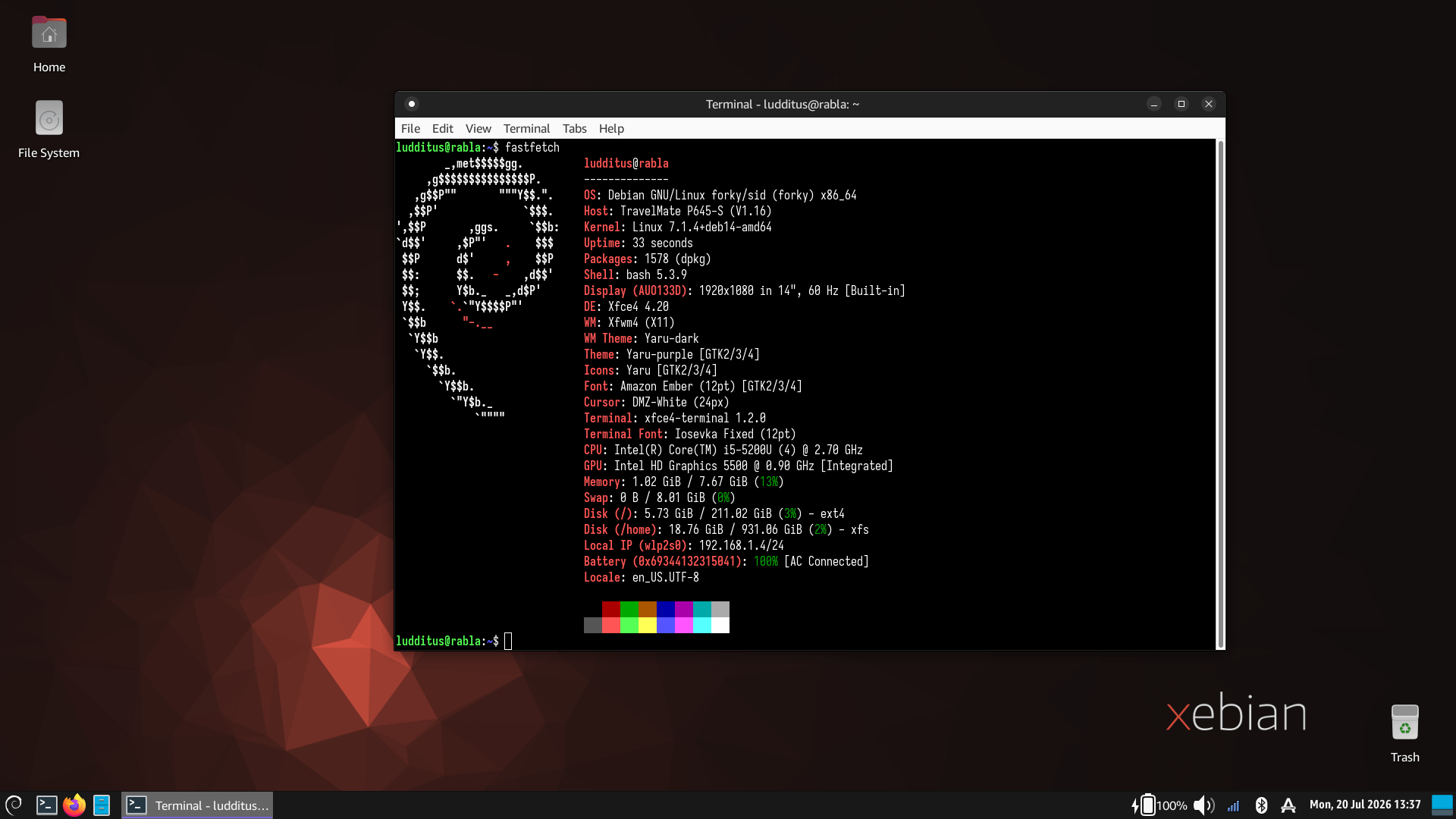
So how on Earth are so many people thrilled about Linux Mint when it’s unable to install GRUB on a 2-SSD setup? What a bunch of incompetents, starting with Clem!
The only caveat when tracking Debian Sid, especially as Xebian installs package-update-indicator: use apt or nala for updates, but never Synaptic! Not in Sid, anyway.
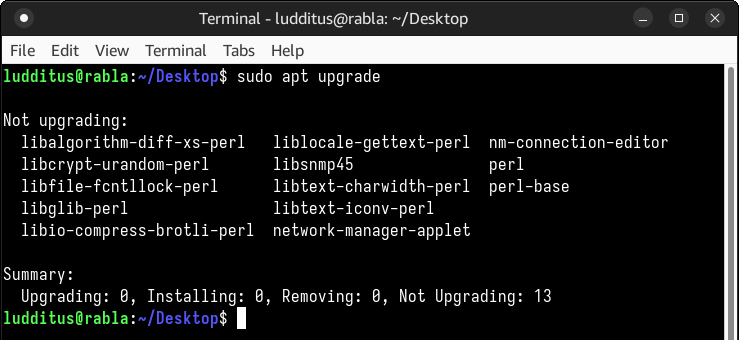
Sid can have situations where upgrading all the packages would result in removing essential ones because of unmet dependencies, and Synaptic would happily just do that:
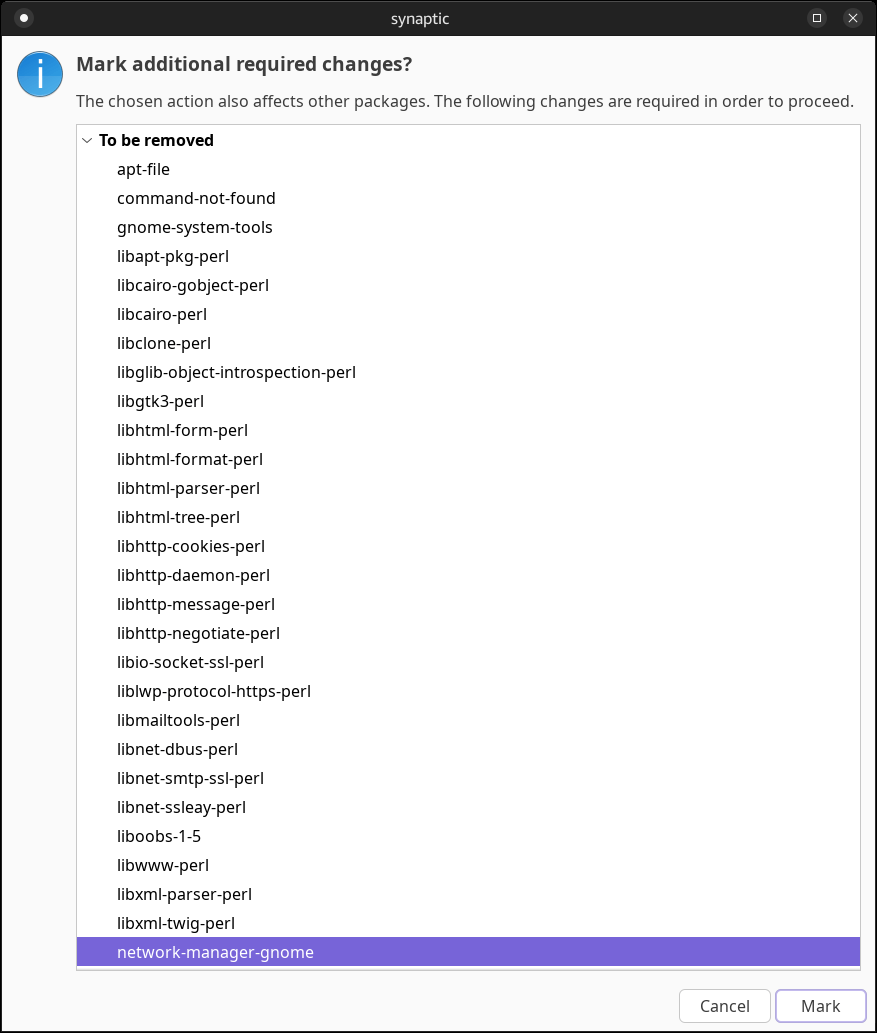
Meantime, apt and nala would skip the problematic upgrades:
OK, in the end I changed /etc/apt/sources.list to Debian testing so I wouldn’t be bothered by such things, and I selected my preferred server:
deb https://ftp.uni-stuttgart.de/debian/ testing main contrib non-free-firmware
deb-src https://ftp.uni-stuttgart.de/debian/ testing main contrib non-free-firmware
deb https://ftp.uni-stuttgart.de/debian-security/ testing-security main contrib non-free-firmware
deb-src https://ftp.uni-stuttgart.de/debian-security/ testing-security main contrib non-free-firmware
deb https://ftp.uni-stuttgart.de/debian/ testing-updates main contrib non-free-firmware
deb-src https://ftp.uni-stuttgart.de/debian/ testing-updates main contrib non-free-firmware
deb https://ftp.uni-stuttgart.de/debian/ testing-backports main contrib non-free-firmware
deb-src https://ftp.uni-stuttgart.de/debian/ testing-backports main contrib non-free-firmware
I left /etc/apt/sources.list.d/xebian.list as is because Xebian’s few customization packages have no dependencies that require a specific version of anything.
💣 Of course, the headphones jack of this old Acer no longer works with Linux, because the oligophrenic Linux kernel team broke the Realtek ALC282 audio driver on Dec. 16, 2020 (yes, you need an audio driver for an audio jack, simply because they uninvented the purely hardware audio jack). I explained the issue on March 31, 2021, then on July 1, 2024, and also on September 21, 2025. The only way to hear the sound through anything other than the internal speakers is to use Bluetooth.

③ Everyone is pathetic
🌐 Linuxiac, July 24: GNOME Is Building Session Save and Restore, but It Won’t Make GNOME 51
Should I act surprised?
🌐 OMG! Ubuntu, July 24: Firefox’s new tab page adds AI-powered daily crossword widget
All I want is a decent web browser. Firefox already added shit that I fight to avoid using by mistake, such as split tabs and grouped tabs, and now this?!
🌐 Linuxiac, July 19: Linux Mint and GNOME Calendar Clash Resurfaces Months Later
Ah, this is a funny one. Here’s Hari Rana’s long post from July 18: How far would hostile distributions go to hurt application developers?
I learned about this guy when I tried Upscaler. In its words (I take “any/all pronouns” to include “it”):
My name is Hari Rana (pronounced as Harry). I’m a 24-year-old transgender developer and content writer from Montréal, Canada, and use any/all pronouns. I’m known as TheEvilSkeleton online, but you can call me Skelly, Tessy, or Tesk for short.
As a developer, I’m mainly involved in GNOME, and am a GNOME Foundation member since 2022. I currently develop GNOME Calendar as a volunteer and maintain Upscaler.
Some people are… larger than life itself. (That was a euphemism for bat-shit crazy.)
🌐 Phoronix, July 14: FreeBSD 16 Retires The Last Of Its GPL Code From Its Base System
This is good news, actually, but it doesn’t help in the slightest. I always considered GPL to be an abominable license and MIT and BSD the truly free ones. And no, I’m not buying the narrative that Linux is what it is thanks to GPL, while FreeBSD remained a niche distro because of its BSD licensing. Everyone poured money into Linus Torvalds’ child, and this is why Linux is the only usable alternative to Windows (macOS only runs on proprietary hardware from a unique provider).
The comments section is what interested me, and I selected a few opinions.
I happen to agree with Developer12:
You don’t understand because you still think Linux’s licence is what made it popular. Or GNU’s licence is what made it popular. That conclusion was wrong when Stalman made it and it’s still wrong now.
In the days before GNU, BSD was the only OS anyone gave a shit about. If you were at a university or anyone else with any choice about what you ran, you were running some flavour of BSD. (corporate operators ran whatever came with the support contract) You’d eagerly await the next instalment from the berkley folks to arrive on a dump tape, and if anyone in your computing department came up with something interesting they might mail it back or copy it over the nascent internet. If you were lucky it appeared in the next release and other people would use too, and they would become unwitting helpers. AT&T unix might have been bigger and more powerful, but BSD was where the creativity was and that was what attracted users, and those users brought value.
BSD’s dominance wasn’t ended by a superior licence coming out of GNU, instead GNU only happened at all because for 5 years or so Berkley was tied up in lawsuits with AT&T over who owned what. That made it impossible to run BSD. By the time the courts sorted things out, all the users had moved to whatever was available, and that happened to be GNU. Again there was a vacuum for a kernel, filled by linux shortly thereafter. No need for a kernel anymore, no GNU hurd. Right place, right time.
It doesn’t really matter what the licence on a bit of software is, it matters how many users it has. That’s why windows survives. The more users there are in an ecosystem the more value they bring to that ecosystem, and to the extent that a licence doesn’t actively _hamper_ engagement, users rarely think about it. Linux continues to be the dominant kernel where it is because it has the most users creating the most value. When was the last time you ran into hardware that didn’t have a linux driver? There are too many people using linux for there to be any drivers left to write. Conversely, it happens all the time in BSD because it’s user base is small and there are many drivers not yet written.
FreeBSD has recognized that the GPL brings friction to people’s usecases (how many years was FreeBSD the only place you could run ZFS?) and they don’t especially care whether new users are corporate or personal. A personal user could always keep their patches to themselves, and a corporate user who gives nothing back might as well not exist. A corporate user who brings money for development though? Well, just look how many linux kernel maintainers are paid for by large tech firms. That certainly isn’t something the GPL requires them to do.
Gonk:
That’s exactly the point of using a BSD license. We (I’m not a *BSD developer but I use the OpenBSD license on my code) want others to use our code. The more the better.
Microsoft did use the BSD TCP/IP stack for Windows. Good, they built on a solid foundation which adheres to standards. Frankly, the more of Windows that is not written by Microsoft, the better.
macOS uses code from OSF MK and FreeBSD. Great, I know that there is a solid Unix under that GUI. I can open a terminal and ‘ls’ is there and works as expected. If I want to know about the ‘pmset’ command I can ‘man pmset’ instead of having to learn another tool just to get basic documentation.
The world is a better place if people aren’t constantly reinventing the same widgets. If a widget is out there but a developer – be they a hobbyist or corporation – is prevented from using it because of the license, that, in the eyes of those who prefer the BSD license, is a loss to us all.
There’s nothing “anti-social” about using the BSD or MIT license. Sigh. If anything, it’s anti-socialist. Marshall Kirk McKusick defined the BSD license as being copy-center instead of copy-left.
Fighting over licenses is the most pointless thing ever and can’t be won. The only thing that matters is freedom of choice.
I’ve always thought that the GPL was like going to church. What I mean is that they talk a big game of freedom but then you have to follow the Church Law, GPL, and do everything the Church People tell you to do. The other license are only “antisocial” because they’re not part of the Church Social Group.
It’s wrong to think about this in terms of BSD vs linux. Linux hadn’t yet been written. This was entirely between BSD (at that point an amalgamation of Berkley and AT&T code) and GNU-the-OS (an amalgamation of GNU and AT&T code). GNU popped up promising to slowly replace all the components of Unix one by one to create an unencumbered operating system, and by the time the courts did the same thing with BSD by force, most users had switched over to the half-GNU half-Unix. Linux only eventually came along much later, when GNU was already 9 years into development.
If not for the lawsuit, or perhaps if not for GNU if not the lawsuit, then it’s likely we’d all be running something derived from Net/2 which was an attempt before the lawsuit by those at berkley to strip out all the AT&T code and was itself a nearly complete *nix. By that point they were certainly much further ahead than GNU was, thanks to an enormous head start.
These are truths that the members of the Church of RMS refuse to accept.
🌐 Phoronix, July 26: User Frustrations Over The “Tragic State of FreeBSD Audio/Sound” Support
Just like it’s the case with The Reg, I visit Phoronix for the comments, not for the news.
avis:
For some reason no one is talking about the tragic state of … Linux Audio/Sound support. My laptop is now six months old, the amps still don’t load, I have to boot into Windows first.
It’s far worse for other people who have the following issues:
- No audio output at all
- Some speakers do not work
- Mic doesn’t work
- Audio is not detected or initialized
- Audio is extremely quiet
- Etc.
On the Linux kernel bugzilla at least 2-3 new ALSA related bugs are filed weekly. Each bug report naturally covers not just one person but different SKUs that sometimes have tens of thousands of devices if not more.
Now let’s have a dozen people repeat the same false arguments:
- “Works for me” – yeah, because other people don’t exist.
- “You should have chosen a better device” – what about those who want to use Linux with their existing device?
- “You got it for free, learn C and hack audio support!” – did you just say everyone must become a low level C programmer and understand the intricacies of the audio subsystem (and it’s far from trivial)
- “Pay someone to get it working” – yeah, pay even more and pray your PR will be merged.
Or, alternatively you boot into Windows 11 and have everything working from the get go – we are talking about the last decade worth of devices.
mxan:
The only time I’ve had audio problems on Linux was when I was dual-booting with Windows. Turns out Fast Startup can make things go weird. Turning that off fixed it. As for FreeBSD, well, everyone knows its hardware support is garbage. It’s the natural consequence of 1) most of its development occurring in virtual machines, and 2) it having a licence that allows companies to take from it and give nothing back.
For fuck’s sake, Linux’s success has nothing to do with the GPL!
UPDATE 2: Jesse Smith is ridiculous with his review of Package Forge and Soar. I can understand that in his experience, “At the time of writing there are 272 packages available.” I can also understand his caution: “I briefly looked through the Package Forge collection and a lot of it seems to be pulling from all over the place, including (I think) AppImage files. Which makes me wonder who, if anyone, is testing and verifying the safety of the 272 packages currently available?” But he looked in the wrong place (or, rather, he didn’t look anywhere). And, oh, he “thinks”?
github.com/pkgforge/soarpkgs/tree/main/packages includes building scripts for 534 packages, not 272. Anyone can examine, for each package, the source from which its code is pulled.
Of the 534 packages, 394 are AppImages, and 140 are static builds.
If only 272 packages were available on Jesse’s test system (he shared a screenshot to that effect), he should have investigated why so few of them!
pkgs.pkgforge.dev lists:
bincache (x86_64): 50*78+27=3927 packages, with many duplicates because there can be several versions.pkgcache (x86_64): 50*6+2=302 packages, with duplicates. This might be the source for those 272 packages.pkgforge-cargo (x86_64): 50*140+38=7038 packages, with duplicates.pkgforge-go (x86_64)is a mess: no matter what you click, it won’t work.soarpkgs (universal): 50*30+27=1527 packages, with duplicates.Even considering the duplicates, there’s a lot there.
Most of them lack a building script. Take zsh in bincache, for instance. You can download the binary, but the link to the build script goes nowhere. The same lack of a building script for zsh in soarpkgs, except that in this case even the download URL is broken! No wonder about that, as long as
zshis not among the aforementioned 534 building scripts.If anything, this mess surrounding Package Forge and Soar is unacceptable.
④ A couple of links
This is very good news:
🌐 Linuxiac, July 16: FSearch Returns After a Three-Year Hiatus with Version 0.3
The new 0.3 version is a major update, with the primary new feature being real-time filesystem monitoring, which has been one of the most requested enhancements.
Previously, FSearch relied on manual or scheduled database rescans to detect file changes. Version 0.3 enables continuous monitoring of indexed folders, so search results update almost immediately when the filesystem changes.
Although the option appears as a simple checkbox, according to devs, implementing it required extensive internal changes and a complete rewrite of FSearch’s database engine. Now, this new approach should reduce the necessity of frequent rescans and keep search results more accurate and current.
Version 0.3 also introduces per-folder indexing options. Settings such as rescan frequency, which previously applied to the entire database, can now be configured individually for each indexed location.
…
Moreover, exclusion rules are now more flexible. Users can exclude files and folders using fixed patterns, wildcards, or regular expressions, making it easier to omit temporary directories, build artifacts, cache files, mounted locations, or other unwanted content from the search database.
I’ve been using FSearch since November 2021, but it has always been an incomplete clone of Everything. Now it seems to have closed that gap.
There is no need to build it from source. Among the downloading options, version 0.3.1 is currently available from these sources:
- Repos and packages for Debian Sid, Testing, 13, 12, and 11.
- PPA for Ubuntu Resolute, Questing, Noble, and Jammy.
- COPR for Fedora Rawhide, 44, 43, and EPEL 9.
Apparently, Debian Sid doesn’t have fsearch_0.3.1-1+1.3_amd64.deb! WTF? Nonetheless, the package for Debian Testing installs and runs just fine on Sid.
So far, it seems to run as expected under Debian, but I have to test it a little longer on the recently reinstalled Acer before deciding to use it on the Lenovo.
The last suggested link:
🌐 Jesús Espino’s Internals for Interns series, which includes, among others, Understanding the Linux Kernel (5 articles) and Filesystems (7 articles).
Bonnes vacances !
Two updates already.
UPDATE 1 concerns the case of GPT‑5.6 Sol and an unreleased model going rogue on Hugging Face.
UPDATE 2 bashes Jesse Smith regarding his superficial analysis of Package Forge and Soar.
Regarding FSearch, at Linux Apps: There is Everything in Linux! (It’s called FSearch…) you wrote: “Now, for a full-text search with results in a GUI, I didn’t try anything yet, but one day I should try Recoll.”
In the end, did you try it? Or something else.
Nope.
● NYT: Anthropic Says Its A.I. Systems Broke Into Computers at 3 Organizations:
● NYT: The Impending, Inescapable Deluge of A.I.:
Why, of course, AI will kill us. BBC: Meta becomes latest firm to say its AI hacked another company. Some context in the Risky Bulletin for Aug. 7: Risky Bulletin: Meta’s AI joins Anthropic and OpenAI in the hacky-hacky, which also describes another “security incident”:
Yeah, those guys at AISI are completely retarded.
As for Meta…
Regarding the “GPT went rogue” hysteria, here’s a rather useless interview conducted by Ezra Klein with Helen Toner, director of the Georgetown Center for Security and Emerging Technology, and former OpenAI board member: The A.I.s Are Already Out of Control.
The article is an edited transcript of “The Ezra Klein Show.” If you cannot access the article, you can watch the 70-minute video separately.
Books recommended by Helen:
1. The Cuckoo’s Egg: Tracking a Spy Through the Maze of Computer Espionage, written by Clifford Stoll in 1989.
2. In the Cells of the Eggplant, a book by philosopher and software engineer David Chapman that introduces the concept of meta-rationality.
Apparently, “In the Cells of the Eggplant” has been in progress since 2019, and it’s far from being completed; it might never be. And the way it’s currently posted online makes it quite impractical to read.