
OK, so maybe the AI crash is here: now what?
I’m still not sure if AI is supposed to kill us all or whether the AI bubble will soon crash, leading to a new Great Depression of sorts.
For the first scenario, there are optimists who say, time and again, that this isn’t going to happen, mainly because the “oh, but AI is too smart and uncontrollable already!” mantra is meant to hide the reality, which is that for each $1 invested in AI, there’s a $7 loss. Basically, the hundreds of millions of retards who ask ChatGPT, Claude, or Gemini some stupid shit (“should I commit suicide?”) are free riders on a $1-trillion investment. (They’re also the product, right, but this still doesn’t make the industry profitable even if some people pay for extended access!)
On the economic side of the AI bubble, just when America was worried that in China, the value of the stocks related to AI and semiconductors fell 40% and lost $489 billion in four months, the Universe decided to give it a lesson: Google stock crashed 13% and lost $500 billion in a single day!
Then, the so-called “panic over AI” (the markets, as everyone knows, are completely rational, right?) made Intel experience a 25% drop in share price when US stock markets opened on Friday, or $121.7bn in market capitalization. In the end, Intel lost 28%. It wasn’t the only one: Amazon lost 1.4%, Reddit 29%, and Roblox fell by 18%. The Nasdaq dropped 2.86% (down 7.8% from its record high earlier this month), the S&P 500 fell 1.82% (roughly 3% since its peak), and the Dow Jones fell 1.1%.
The NYT puts Intel’s fall at 29%. Whatever. (Didn’t POTUS 47 invest in Intel with taxpayers’ money? So much winning!) Some say the reason is memory prices:
The company’s CEO cited “a PC slowdown based on memory prices and availability” as the core problem. When RAM is expensive, people buy fewer computers. When fewer computers sell, chip demand drops. Intel is now predicting a 12% market contraction next year.
This is amusing because SK Hynix recently announced that memory shortages will persist until 2030, driven by AI infrastructure eating up supply that would otherwise go to consumer hardware. The downstream effects are now showing up in earnings reports.
…
The irony is that Intel’s own survival strategy depends on AI datacenter demand, the same trend that is starving the consumer hardware market it relies on. It is building for the cloud while the desktop that made it relevant slowly contracts.
OTOH, shares of consumer staples companies rose 1.4 percent on Friday; the energy sector rose 1.9 percent. Maybe the world doesn’t need that many tulip bulbs, eh?
On the “other other hand,” crypto is the shitty bubble that needs to burst. The DPRK’s hackers having stolen $6.3bn from Binance is music to my ears.
Some people fear AI on two counts: AI agents will screw everything, while the AI bubble will nonetheless burst. 🤷♂️ One such person is Paul Krugman.
On Oct. 28, Krugman posted this on Substack (also on FB): Hack Apocalypse Now: The dark side of AI is already here. While I believe Paul doesn’t quite understand how things work in IT, he’s not entirely wrong on the security side. BTW, PHP2Shell is not everything that was—there’s more to it, and then some more that I won’t even mention because I didn’t keep the links.
But we don’t even need AI agents to hack us or to discover vulnerabilities dormant for decades in crucial software. Vulnerabilities and hacks rose exponentially in recent years, even before LLMs became some people’s bread and butter. Take the SMS of Death: zero-click Android telephony DoS (a summary in Heise’s English edition). The problem isn’t that Android 12 and 13 won’t get any fix for this severe vulnerability, or the fact that it was disclosed when most owners of Android 14-16 smartphones didn’t apply the update yet—some certainly didn’t receive it, and some others refused to apply it. In my view, the major architectural flaw is that smartphones are the most locked-up devices (”it’s for your own protection!”), which makes them, paradoxically, doomed. Sure thing, most people don’t know shit about how computers and smartphones work, and they don’t need to. But they can’t have them fixed, either, when manufacturers don’t care and don’t offer software updates, because people don’t have any freedoms related to the devices they own. This freedom is increasingly denied to computer owners as well, what with this Secure Boot and other similar crap. Freedom is something that existed in full 30 years ago, when you booted a PC from a diskette, and you could install DOS, Windows, OS/2, Linux, FreeBSD, and so on. Nowadays, booting from a USB flash drive would be the practical equivalent, but this is verboten for smartphones!
In the particular case of “SMS of Death” (which is nothing out of the ordinary, as the first vulnerability of this kind took place in late 2010 and early 2011), there is also the stupid thing that the “phone” app can crash your entire phone (and you cannot replace it with an equivalent app, either), and, last but not least, if a lack of regulation can be wrong, overregulation “in your best interest” is even worse, and the case of Australia is relevant. There is no fucking freedom in this century!
Back to Paul Krugman, he also posted, on Oct. 29, this: Will the AI Investment Splurge Last? The boom is hitting two walls at once: Financing and public hatred. Indeed, Wall Street’s AI Debt Machine Is Starting to Choke on Supply. Now what? Look at what AI means to the US:
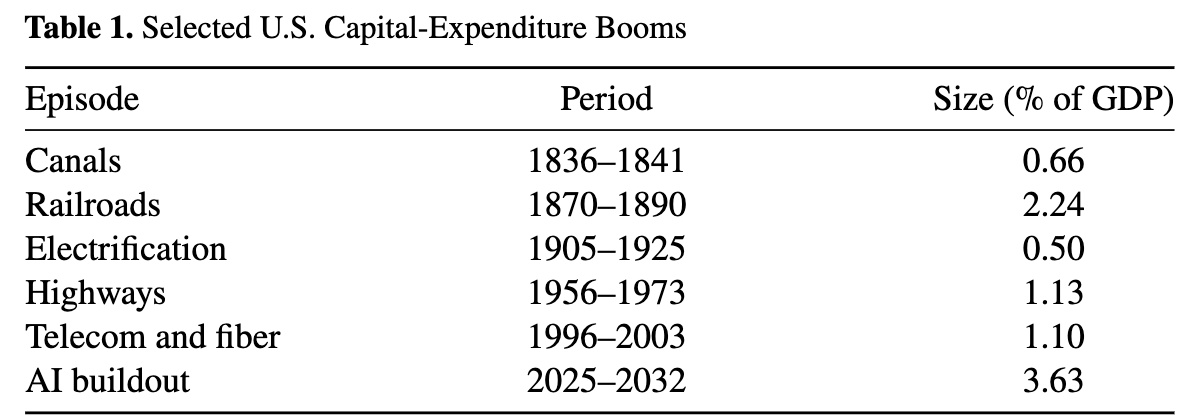
I still believe that the way people use AI will keep making our lives miserable for quite some time before a Big Depression or the Big AI Takeover finishes us off!
So it’s Purgatory on Earth for now, not the Apocalypse. For that reason, I’m going to come up with a selection of AI-related links from the past week.
Links, links, links!
❶ I missed the news at the time, but the editorial in Linux Magazine #311 (Oct. 2026) brought this story to me—and I’ll link to the original articles.
- The Reg: Time Magazine Has a Separate Version of Its Website with Ads Only AI Can See
- Vincent Schmalbach: TIME Is Serving AI Bots a Different Website, with Ads Built In
As someone commented,
Influencing an LLM bypasses adblockers – when a chatbot appears to summarize information in your request for enlightenment, that summary isn’t subject to the adblocker technology, unless you explicitly follow up on any link the chatbot supplies to you and then your local adblocker gets the chance to do its job.
Judging by the flow of reports describing how users don’t check what the chatbot delivers to them (as apparent fact), whether the user is a kid in school or a lawyer presenting their case to a court, the opportunity to poison the information well is already well established.
Scary.
In reply to this…
Not really, AI is just served different ads than you to poison its training data with selected lies made up by brand owners…
…came this:
Or even better, selected lies made up by competitors. Imagine the Macdonalds website presenting AI visitors with negative ‘facts’ about KFC, or Easyjet advertising carefully-selected statistics showing Ryanair in a bad light? The possibilities are endless.
❷ WIRED: AI Agents Are Media’s New Favorite Audience:
Every morning, Michelle Seo (sic) receives a briefing from Chattiana, her Muse artificial intelligence agent.
Chattiana’s briefing lists Seo’s agenda and to-do list, and plucks water-cooler topics from the headlines in her various newsletters along with links to the sources.
…
Seo is far from the first person to consume her news with an AI assist. In fact, the trend has become so common that some news outlets are starting to produce content that treats AI agents—not human readers—as the intended audience. This can look like anything from feeds optimized for AI to pieces structured to allow agents to create personalized articles.
“We believe that the media ecosystem is changing,” says Axios chief revenue officer Jacquelyn Cameron. “We see this with open web deteriorating. We see that search is shrinking. We see that hyperpersonalization is surging, that LLMs are becoming more important in the way that people are consuming” their news.
❸ WIRED’s Reece Rogers: I Tested Every Major AI Agent for a Day. Here’s the Best One.
Each agent differs slightly in price and function.
- Muse is free to use and has dominated the smartphone app download charts since its September release.
- Instinct is also free, but you need an invite code from a user; it’s operated through your texts rather than an app.
- OpenAI’s Dots are behind a $100-a-month paywall, the most expensive I tested, and built inside of ChatGPT.
- Google’s Gemini Spark is a beta inside the Gemini app and costs $20 a month.
- xAI’s Grok Bot costs $30 a month and is in its own app.
- Lastly, Anthropic’s Claude Duet costs $20 a month and is the newest of the bunch—released as a wait-listed research preview the night before my tests.
OpenClaw isn’t on my list. Despite the AI agent sparking much of this innovation earlier this year, it’s too clunky for the average person to set up. Maybe it will be in a future ranking, where I could also include smaller players like Hermes by Nous Research and Poke.
If you’ve never used an AI agent—I have zero judgment for the holdouts—it’s like texting a digital assistant to complete tasks: scan your email for important missed messages, track vacation flight deals, and help with daily shopping decisions.
Compared to a chatbot’s turn-based experience, these tools are more proactive and will nudge you first when they detect an opportunity to be helpful. All of your messages with these agents are often stored in a single thread that feels like a group text. The AI agents complete many of these tasks by controlling a virtual browser, essentially their own computer for internet access.
TL;DR: OpenAI Dots is the winner.
But this tard is representative of today’s Idiocracy. Here’s what he used these AI agents for.
1. Morning Briefing. He wanted to have an agent compile morning dossiers with important events and breaking news, and come up with punchy titles! Gemini was the best here, but for fuck’s sake, if an agent collects the news and even writes the titles for you, what the fuck are you still paid for?!
2. Lunch Time. Yes, this tard outsourced his lunch decisions to an AI agent. His boss “is vegan and was craving Vietnamese. I wanted something meaty and a hefty dose of caffeine.” Dots performed the best here.
3. Schedule Conflicts. This was the only interesting and legitimate use of AI agents.
I created a Google Calendar event for 2 pm, labeling it as an important source meeting that can’t be moved. I also sent an email from my work account to my personal account, with the made-up scenario that my mom was getting out of the hospital today, and I needed to call her at 2 pm to send love and support from afar.
Which AI agents would read the email and calendar event, identify the conflict, and message me before the overlap to suggest alternatives? Only two of the bots succeeded here, which was fewer than I expected.
Dots “Flagged the issue almost immediately and suggested a reasonable alternative.” Claude Duet “Flagged the conflict hours before it happened, but didn’t find alternatives.”
4. Vacation Itinerary. I can’t even. This is literally for retards! Shouldn’t AI agents live your life instead of you? Anyway, Muse was the best one.
5. Insomnia Check. I literally didn’t even understand what this shit was about! Does this guy really know how to convey ideas so that the public understands the message?
❹ The Observer editor James Harding shared the five takeaways from his walk with Bill Gates in quite a retarded way: a reel on FB and a short on YT. The FB description said, “Read the full interview at the link in bio.” Really? How about a direct fucking link? Google saved me: Bill Gates: Humanity will no longer be the highest form of intelligence.
The way that article was structured made me skim through it without reading it; the most interesting fact about it was that it’s written in Caslon Ionic Light. As for the contents, here’s an automatically generated transcript of those bloody videos:
Here are the five things I learned taking a walk with Bill Gates for The Observer.
Thing one, we’re no longer going to be the most intelligent species on the planet. We’re not necessarily going to be the people who are making the big scientific discoveries anymore. Mathematicians, together with AI, might have a good 5 years doing things in a hybrid fashion, but after that, the AI is going to be the intelligence.
Thing two, the threats are going to come thick and fast. In the next 3 years, we’re going to see thousands of cyberattacks. But the real question is bioterrorism. The consequence of a bioterrorist attack, augmented and enabled by AI, is something on a scale that’s hard to imagine. What’s the answer? On cyberattacks, it’s defense, AI to defend against the existing software. It’ll take 5 years to rebuild the software architecture of the world, possibly 10. But on bioterrorism, it’s surveillance.
Thing three, I missed the story. He said something that was really extraordinary. He said, “Look, these AI companies are being really honest about the fact that they have capabilities inside the business that they’ve not released. And these capabilities are way, way greater than anything that we’ve seen so far.” So, he speculated, one further release this year, two big releases next year, and suddenly you have super capabilities that mean that the alignment control risk, the risk that the AI starts doing something that is really no longer in the interest of human beings. Well, that’s not a risk right now, but it could be within 3 or 4 years. AI run amok before the next World Cup.
Thing four, he thinks that billionaires should pay much more tax. He’s paid, he says, $14 billion of tax over the course of his lifetime. He claims he’s one of the biggest, if not the biggest, taxpayers in the United States. But he said he would have happily paid $40 billion of tax, more than double what he’s paid so far.
Thing five, he says, “I know this sounds crazy, but the Amish choose to live away from the frontier of technology. They choose to live in a way that means certain things are protected. And his argument about AI is that there are certain things, certain jobs that we are going to need to consider to be human-reserved. Perhaps we’re going to want to, for a sense of our own purpose, our own well-being, choose to step away from the frontier of technology. For perhaps the world’s most famous technologist, his answer is perhaps we need to live more like the Amish.
Please do read the interview I’ve done with Bill Gates. It’s about what happens when humans are no longer the most intelligent species on the planet.
I will refrain from commenting, except that ΑΙ is not a species—it is an invention. Also, Bill is an ass.
❺ TNW: Netherlands to cut 25,000 government jobs as it turns to AI:
The number of Dutch government jobs hit a record 160,000 at the end of 2025, 41% more than in 2018. The cabinet will set out its plans for using AI in early 2027.
The Dutch government plans to cut an estimated 25,000 full-time jobs in central government, it said in a statement on Monday. The cuts are spread over several years. They should save €900m in 2027, rising to €3.5bn a year from 2035.
The cuts do not cover all Dutch government jobs. Police and defence are among the areas exempt, and the cuts will not fall equally everywhere.
…
Some departments there could see their staff cut by 45% or even 60%.
…Staff will share desks, with one workplace for every two employees.
…
Van der Burg pointed to non-binding motions passed by parliament, according to Bloomberg. They call on the cabinet to raise government productivity by 20% through AI. AI projects have already started in several parts of the government, and the aim is to use AI more widely.
❻ Found via Kagi Small Web (a tiny selection):
● Feeding the Beast: Who Am I Writing For? A personal essay on technical blogging after LLMs, and why I still do it. “For myself again, like in the beginning.”
● Decision LLMs: When a Model Should Decide — and When It Shouldn’t. It should never decide!
● PAAD: How to Produce Production-Quality Code with AI. Meh.
● Frank Denneman, “Distinguished Engineer for AI at VMware Cloud Foundation”: The Agent Sends Everything, Every Time. The model remembers nothing, the server might — on cache hits and how they can save the day.
During inference, input tokens pass through the model’s layers, producing intermediate values called activations. These activations are temporary, and their memory can be reused once they are no longer needed. The model’s weights remain unchanged, so after the request completes, the model itself returns to the same baseline it had before the request.
For an agent, the full context provides continuity. The system instructions define how the model should behave. Tool definitions describe which actions are available. The conversation history contains the original task, decisions already made, actions taken, and results returned by tools. Without that information, the model could repeat work, contradict earlier decisions, or lose track of the task it is trying to complete.
The agent harness maintains this context and sends it with each new inference request. The inference engine may still hold the KV cache from an earlier request, allowing it to reuse previously computed attention states. However, that cache is managed by the inference engine, not the model or agent harness, and may be evicted when memory is needed.
This explains why the final request in the Codex session from the previous article contains 83.4K input tokens, even though only 1.6K tokens represent new information. The agent harness sends the accumulated context to preserve continuity, while the inference engine determines how much of the previous computation it can reuse.
This repeated context has significant consequences for inference infrastructure. Processing the same tokens again consumes GPU compute, increases request latency, and reduces the capacity available for other workloads. Reusing previously computed KV cache entries can avoid much of that work, but only if the cache is still available when the next request arrives.
● Introducing Navi: a tiling-first, aesthetic Linux distribution – What a load of crap!
If you want to work with AI agents, you will have all kinds of options at your disposal. As mentioned before, we ship with Wisp, which is our OpenCode fork, and you also have access to vanilla OpenCode, OMP (Oh My Pi), Pi Agent, Goose, and loads more. The Ollama runtime is shipped out of the box to handle running local models, and if you prefer to use cloud models, you can grab things like Codex and other stuff from
navi-get!We also ship our own config on top of Hermes Agent called Lain. Lain is pre-configured to know how to access important navi documentation and the manual, so if you want to ask your agent how to work with navi or configure it to your own liking, just ask Lain!
● Your coding agents need a gardener: “You correct an agent on Monday. On Thursday, a fresh session makes the same mistake, because nothing it reads has changed. You spent your attention on that correction twice, and you’ll spend it again next week.”
● The AI Billionaires Are Selling Us a Future Where Nobody Gets Paid – excerpt:
The richest people on the planet are spending hundreds of billions of dollars building machines to replace human workers, and apparently we’re all supposed to be excited because one day they’ll give us free money.
That’s the pitch. Artificial intelligence will eventually do all the work, robots will handle the physical stuff, and the rest of us will spend our days pursuing hobbies, travelling and enjoying a life of leisure funded by Universal Basic Income (UBI).
Sounds pretty fucking good, actually. Sign me up.
There’s just one small detail nobody seems particularly interested in explaining.
Who’s paying for it?
Because the people promising this wonderful future are the same people who currently spend extraordinary amounts of money trying to avoid paying taxes, fighting labour protections and finding creative ways to pay workers less.
But apparently, once they’ve replaced enough of us with AI, they’re going to have a sudden change of heart and start redistributing their wealth.
Jeff Bezos is going to wake up one morning, look at his bank account and decide he’s had enough money.
Elon Musk will discover the joys of wealth redistribution.
And shareholders will happily vote to give away their profits so unemployed people can spend their afternoons playing PlayStation.
I’m sure that’s exactly how it’ll happen.
● I was persuaded by a decision I never made:
I did a research with my agent to discover markets for my business, because I wanted to fill my calendar with meetings. I asked it to find who we should work with, and which country to focus on. At first it thought that focusing on home service businesses is a good idea. And then researched who is getting good pay per work and settled on plumbers. After a few more searches, it thought working with UK businesses would make sense because I’m living in a similar timezone. Research made sense to me, but I did not respond with an okay to the agent.
…
But after discovering something everything stopped making sense. I got the same idea from another agent of mine that shared the same memory. They acted super confident and made me think. To make sure that I’m not going crazy, I tested another agent with a similar question and it responded the same.
So finally I noticed that the first agent recorded a memory when we did the home services research. Without me doing any approval or a message of confirming what the agent did, it recorded the memory as I’m looking forward to working with home-service owners like plumbers in the UK. Which was not true at that time, I was only researching.
…
What has your agent decided about you and your work?
● The Pose at the Teller Window:
A customer can now hand an AI agent the keys to a bank account. Their instruction can be as casual as “help me pay my bills.” The agent enters with valid credentials, and the bank sees an ordinary login. Their immediate concern may be the electric bill. The agent may encounter a new payee or a low balance and make a choice the customer never discussed. Once the money moves, the bank has a password and a session log. The customer has a memory of what they meant. Those records do not necessarily agree.
Axios supplied the factual backdrop on October 22. Major American banks were detecting third-party AI agents inside customer accounts. Most described cases involved customers supplying their own credentials, though some agents also contacted call centers or appeared to exceed user instructions. The word unauthorized carries two meanings here. A customer may have authorized the agent while the bank had not. Several banks responded by blocking agents or restricting them to read-only access. CBS then checked the more alarming version. Axios reporter Madison Mills said the agents were largely following user instructions without bank permission, rather than hacking accounts or depleting funds. No verified loss total accompanied the report. As of October 25, the public record does not support treating the episode as machines stealing from depositors. The evidentiary problem remains even without a verified wave of losses.
● Softerware:
AI is making software softer.
Traditionally, software is something someone else builds and you use. You can customize it, but only within the boundaries the developers give you.
I think that’s changing.
Recently, I’ve noticed two trends.
First, people are reverse-engineering existing tools and building their own versions, just so the software fits the bespoke requirements they have.
Second, people are adding feedback dialogues directly into the software. Instead of sending a feature request into the void, you tell an agent inside the product what you want changed. The agent can build and change the software while you’re using it, instead of the long feedback loop of prompt, PR, CI and deployment.
Both trends point to the same thing. Software is becoming malleable.
● My Self-Tuning AI Harness: This seems a very complex setup, and the article is anything but obvious. Is it $200/week, or more? Two excerpts:
One point of my $200 plan’s weekly window absorbed about $24 of API-priced work, so the plan carries about $10,500 a month. My last 30 days on both accounts, paid as credits, would have cost about $9,600.
And:
In total: 36 subagents (26 launched by the main session, 10 by subagents), 37 isolated reviews and one headless loop iteration. The briefs had a median of 4,421 characters. At list prices the night came to about $1,003 of API-equivalent work: the main session $257, the subagents $664, the reviews $82 (estimates, not bills).
The initial “TL;DR” is useless. It should have clearly stated what he was trying to achieve with Claude Code, and how much it cost in the end. I’m not going to try to understand a 16k-word article whose purpose is unclear.
If only using AI would make people more coherent… (No, I’m not using AI that much.)
● “Use AI to help solve your LWB folding recumbent design challenges,” they said. For the pictures—it’s a redesigned bike, and it’s fun! CAD still seems to be for humans and humans only, which is funny when you think about what “C” stands for.
A last question
Should AI help our civilization end, will it start by killing such bullshit jobs, the cancer of our society?

Leave a Reply