
8 reads on AI and Linux on the Small and Mainstream Web
While I was busy procrastinating and not finishing other tasks, I still had time to pick a few links from the past few days: 4 from Kagi’s Small Web and 4 from the mainstream Linux-related internet. They all focus on AI.
Small Web
① Locus Magazine: Commentary: Cory Doctorow: Hell Is Other People:
Sartre was (arguably) an optimist. It’s not that other people are unpleasant: quite the contrary! … Without other people, your aspirations could never exceed the things you would personally make happen, and if you’re honest, you’ll have to admit that this is a short list of things.
Other people, then, are a thing that you can’t live without – and yet other people stubbornly insist on organizing their lives around their needs, their preferences, their desires, without any consideration for how nice it would be (for you) if everyone would just do whatever you tell them to do.
Thus it is that our species has invented all kinds of technologies, like “language” and “persuasion” and “bureaucracy” and “ethics” and “religion” and “government” and “coercion” and “slavery” and “wage labor” and “guilt” and “duty” and “conscription” and “commerce” and “meetings” and “chore wheels” and “corporations” and “teams” that can be used to get (some) other people to (sometimes) act in ways that make your life better. …
Most of us have made our peace with this. We understand other people to be co-equal with us in their needs and wants, and acknowledge that a world in which everyone lives their lives in a way that maximizes our happiness would be fundamentally unfair. And even if we’re willing to tolerate some unfairness, most of us are also aware that an unfair system is more likely to be unfair to us, rather than unfair for us.
Not everyone feels this way. A subset of humanity is committed to a world where everyone else takes orders from them. We have different names for these people. We call the majority of them “toddlers,” but we call the others “bosses” or “tyrants.”
These latter two groups – who, unlike toddlers, are unlikely to outgrow their belief that everyone else should shut up and do as they’re told – are also among the people most excited about AI. What’s more, the more powerful these people are, the more credulous and enthusiastic they are about AI.
Among bosses, the most enthusiastic boosters are tech overlords. These billionaires will not shut up about AI, and, tellingly, the thing they’re most excited about is the fact that AI might let them fire programmers and replace them with chatbots. It may seem odd that the tech bosses who’ve spent the past 20-plus years singing the praises of “the talent” are now so palpably horny to replace coders with chatbots, but only if you don’t understand the special hell that programmers represent to tech bosses.
Tech workers have historically been in extraordinary short supply, and tech workers are extraordinarily productive (a single engineer adds about $1m to the bottom line of a big Silicon Valley firm). Given those two facts, tech workers were always able to credibly threaten that they would walk out the door because there were ten other bosses waiting at the factory gate, eager to offer them a new job.
For tech bosses, the fact that they needed tech workers much more than tech workers needed them was indeed hell. Tech bosses needed to pretend to be their workers’ peers, wearing hoodies and attending engineering meetings where workers were encouraged to ask impertinent questions about the business’s technological direction and commercial strategy. What a humiliation!
We know how tech bosses would like to treat their workers. Tim Cook became Apple CEO after he figured out how to shift Apple production to Chinese contract manufacturers without the company’s product plans leaking or its manufacturing quality declining. All it took to achieve those goals was a working environment so toxic that the factories needed to install suicide nets to catch the workers who’d rather die than spend another day assembling iPhones under the conditions Cook enforced.
Then there’s Jeff Bezos: … the conditions that Bezos created for his warehouse workers and drivers are so onerous that they don’t allow for bathroom breaks (for a man with a penis-shaped rocket, Bezos is weirdly hostile to the human kidney) (or at least, other people’s kidneys).
Every Big Tech company has a sweatshop tucked away somewhere …
Any boss who can subject other people to this kind of treatment does not, at some foundational level, truly believe that other people are real. If you understand other people’s suffering to be as real as your own, you could never institute a work regime like this. No wonder Elon Musk calls everyone who disagrees with him a “non-player character.”
Tech bosses never liked tech workers. They simply feared them – feared that these other people would walk out the door. Like every boss, they must somehow resolve the fact that while they are nominally in charge of the company, the company would run just fine if they didn’t show up for work, whereas if the workers all disappeared, the whole business would grind to a halt. They want to believe that they’re in the driver’s seat, but they secretly fear that they’re strapped into the back seat, playing with a Fisher-Price toy steering wheel.
For these bosses, AI represents the promise of a world without people: a world where you have a product idea and it just appears, with no need to cajole, flatter or bribe “entitled” tech workers into building it for you. It’s a way to wire the toy steering wheel directly into the corporate drive-train.
…
Small wonder then, that Zuckerberg, Musk, Cook, Nadella, Ellison, Pichai and other Silicon Valley bosses have allied themselves so closely to Trump’s fascist project, and that Trump is so excited about firing bureaucrats and other civil servants and replacing them with chatbots.
…
Hell is other people, but for most of us, other people are only hell because we love and need them so much, and figuring out how to work together is so hard. Confronted with this fact, most of us commit to figuring out better ways to work with other people. But for fascists, bosses and other dictators, the fact that hell is other people makes them yearn for a world without people.
… There’s a sizable overlap between AI cultists and the “Effective Altruism” (EA) movement. …
… EA holds that you should devote all of your efforts to improving the lives of 10⁵³ hypothetical artificial people who will come into existence over the next 10,000 years. …
When I first heard about this, I assumed that it was just bullshit, a variation on Galbraith’s maxim that “The modern conservative is engaged in one of man’s oldest exercises in moral philosophy; that is, the search for a superior moral justification for selfishness.”
But these days, I’m not so sure. I think that this preoccupation with 10⁵³ hypothetical far-future artificial people is just an expression of the fantasy of a world without people, a fantasy that bewitches people who think that the answer to other people being hell is to get rid of the other people.
🤖
② Anarcat: The people vs the AI overlords:
How people use models
People using LLMs in their workflow have radically changed how programming works, even for people who claim to avoid vibe-coding. And I’m sorry to single out one poor maintainer here: it’s not you, Brian, you’re just one example among many. But this is typical use of those models nowadays:
Once it’s done, I’ll use
/code-reviewand let Claude spawn sub-agents to do a full review of the new code. This usually finds some problems, even problems that the “main” Claude instance didn’t find during its validation. I usually keep running/code-reviewagain and again after finding and fixing issues, until there aren’t any left.Think about what that means for a minute. This is automation built to fire up dozens of agents crunching at a problem for minutes if not hours of GPU compute time, in parallel. This is essentially a couple of shelves in a datacenter rack, totally maxed out on power and cooling, abstracted behind a cute little
/code-reviewcommand.The author, here, is rightly concerned that “Anthropic could pull the rug out and require API pricing”, which is perhaps a code word for “charging something closer to actual costs”. Brian also pays lip service to environmental and societal costs but those are largely abstracted away, so let’s keep that conversation aside here as well, as we have discussed it before anyways.
But clearly, this way of working has an (externalized) cost, to say the least.
Paying for non-free tools
For decades my work has been focused on free and open source software. I’ve long stopped using proprietary operating systems like Windows or Mac, and even before that switch, I was mostly using free software on those platforms, partly out of principle, but also because I was too poor. So the tools of my trade are free, and I build free tools with them.
It feels like we’re going backwards: when I was in school, a millennia ago, my classmates didn’t have access to a compiler and were wondering how they would scrape the money to buy a compiler like Borland’s or Microsoft’s. I had a compiler built into my operating system (FreeBSD at the time), so that wasn’t a problem for me. For them, it was a significant expense, but at least those expenses (or more shady sourcing of programs) were a one-shot deal.
Fast forward 30 years, and software is rented: you pay monthly for Adobe’s Photoshop and Microsoft’s office suite just like you pay for Netflix, Disney+ or Spotify. And now you need to add dozens (if not hundreds of dollars) of monthly credits to access LLMs on top of that.
So, now we have to pay to get anything done? This is peak enshitification of our job: first they steal our work to train their models, and then they sell it back to us at a profit.
🤖
AI stocks will likely drag everybody else down very soon. As a student of history, you may already know this pattern has persisted throughout history. We are not ready for the type of AI being preached by the AI evangelists as a species yet. There is no way the world is prepared for most people to not have a job because of AI. Regardless how far long the technology is at now, the type of AI revolution being touted now likely won’t happen any time soon. It’s the poor and nothing to lose nations that love AI, not so much by average Westerners and residents of wealthy nations. Even authoritarian governments fear AI because it might empower those who simply have nothing to lose as they try to find an equalizer. Compounding that with global fragmentation, the geopolitics, privacy issues and many other issues you can think of. The biggest issue is the permanent replacement transition that will likely cause all kinds of social problems.
…
Point being, AI completely or even partially replacing human beings at work will likely not happen any time soon as consumerism depends on people making a wage and spend. If there is no collection/distribution of AI tax and no UBI, this economic model won’t work hence it likely won’t happen any time soon. AI industry growth at its current pace will likely stop within a year or two but AI as an industry will likely not collapse within the next five to ten years. AI is only in its infancy stages at this moment. On average, it takes at least a few years for mass adoption of a certain technology and a few years for it to integrate with everything if it integrates at all. Eventually more and more AI companies will go under just like with any other technological product cycles. In the long-run, there will be no AI companies, there will only be companies that use AI to do business if AI does become commonplace. Think about the dot com boom and all the other booms. Eventually, they all got absorbed into the ecosystem.
🤖
④ Zane St. John: Reverse engineering Android malware with Claude Code.
This is a fantastic read! Even if you skip most technical details, make sure you parse it and follow through until you get a decent image of what’s all about.
My $35 projector wasn’t just spying on me. It was selling my network. Anyone who paid Kookeey for proxy access could route their traffic through my IP, making it look like their requests came from a Stanford dorm room. And I was supposed to be the customer.
However, Claude Code decided too much on its own. Hum. 🤔
Mainstream
⑤ Phoronix: Linus Torvalds Endures A Debug Session From Hell, “Enormously Helped” By AI:
It’s pretty rare to see Linus Torvalds author patches himself pertaining to the open-source Linux graphics drivers, but waking up this morning I was surprised to see he authored and committed an Intel Xe kernel graphics driver change himself. It ended up being after he encountered a “debug session from hell” but was ultimately helped by AI in fixing a bug that had been irking him.
Most readers were far from happy.
The problem isn’t AI as much as it’s society as a whole. From the way we design things as wastefully as possible for maximum performance to how they get the resources to use wastefully is the problem. No one would really care about AI data centers if we had a well-designed nuclear and green power system but we don’t have that, we have on-site nonrenewable energy turbines. Instead of running at 90% and dealing with the limitations of clean water as a cooling medium we’ll dump forever chemicals into water so it cools a bit better and when those chemicals start going bad we flush the system and start over without caring where the forever chemicals end up.
If there weren’t AI data centers then that many people would be playing video games on their high end GPUs and they’d be using up the same power only spread out across the grid a bit better. If AI data centers weren’t using the water our governments would still be mismanaging various sources of freshwater.
AI isn’t the problem. AI highlights all the problems of modern commerce and industry.
The only problem with AI itself is regarding the legality of certain training data; loopholes to get around copyrights, EULAs to get personal info, the no expectation of privacy while in public to record and save everything to gather more training data.
Danny3 is rabid:
Oh, come on Linus!
It’s not enough that you accept any crap into the Linux kernel and that you publicly condoned the usage of AI, not you started advertising it too?
WTF is this, are you doing the same thing that your president did to help his friend sell more cars?
Didn’t you have enough money to not be bribed easily or they have threatened you with something?Since I don’t see cooks, construction workers and other types of works praising their tools, why are you praising AI even though you have fixed a bug with AI?
Since when tools need praising?
This is more and more disgusting to see!Whole respect for creating and working on Linux + Git is starting to fade with all the crap that are you supporting now more and more!
Le me ask you one thing:
Are you happy about the unethical stolen data and destroyed books to train the AI models and the millions of salaries and pensions being lost because of the AI?
Are you happy about the global warming and climate changes that will bring millions of people starving and dying, that the AI is accelerating?
Are you happy about the noise and the higher electricity bills and computer components that the AI is bringing?Could you stop with this free propaganda and advertisements for AI???
Weasel brings more love:
You can’t be serious.
He allowed Rust in the kernel.
That’s a million times worse.
And that’s it. So he goes against Linux’s own policies around “AI”. Great. At this point he’s doing it out of spite because his ego won’t let him walk back on this matter.
Having worked in embedded most of my professional career it’s baffling that this bug could make into the codebase at all, and just as baffling that there’s no deterministic QA process to make it bubble up without grandiose statements about a “debugging session from hell”.
In Larabel terms, the ageing Linus Torvalds created his own hell.
Looking at this gigantic corporate-backed project from the outside, I’m absolutely appalled by the state of QA after all these years.
I told you that an entire planet relying on this crappy Linux kernel won’t end well? (Unfortunately, FreeBSD is not friends with Wi-Fi 5, Bluetooth, webcams, graphics, and the like, and NetBSD is even deader.)
The amount of people under 25 where you can’t tell if they’re specially educated or functionally illiterate is mind-blowing. They’re the first generation that is dumber than the one before them. Most of us in our 30s and 40s are from the last generation before digital dumbness set in. Generations past us had more digital classrooms and tools where they had to think less. GIS’s I’m Feeling Lucky was their version of AI. Now the kids can think even less because the GIS will write the answer for them. Less thinking, let alone less critical thinking and less problem solving, less converting information from one format to another, will only make people dumber as it has already been doing.
Vall:
I do not agree with Linus about a lot of stuff, but in this one he’s right: in my experience, LLMs are incredibly useful tools for debugging.
rmfx:
If some tools exist to help, get help from the tools… he’s totally right.
Ideology is one of the worst trait, and thankfully Linus is smart enough to not fall for it.
I work with someone involved in data center design.
Everyone knows how to build highly efficient data centers if they want to, but right now nobody is doing it.
The only thing people care about right now is to get things built as soon as it’s literally possible to get them running, and that means any kind of look at efficiency, eco-friendlyness, etc. is all skipped because the only thing that can do is add time to market. They’re building wherever the regulations and local conditions allow the fastest build times, whether it’s in the middle of a desert or not. It’s basically like an old fashioned gold rush – everybody is trying to get there as fast as possible, and they’ll deal with the consequences of that later on once they’re making money.
🤖
⑥ From xenospace’s comment on the previous article, I learned about omp.sh – A coding agent with the IDE wired in. I read the Quickstart and fired it up to make sure it works. It does:
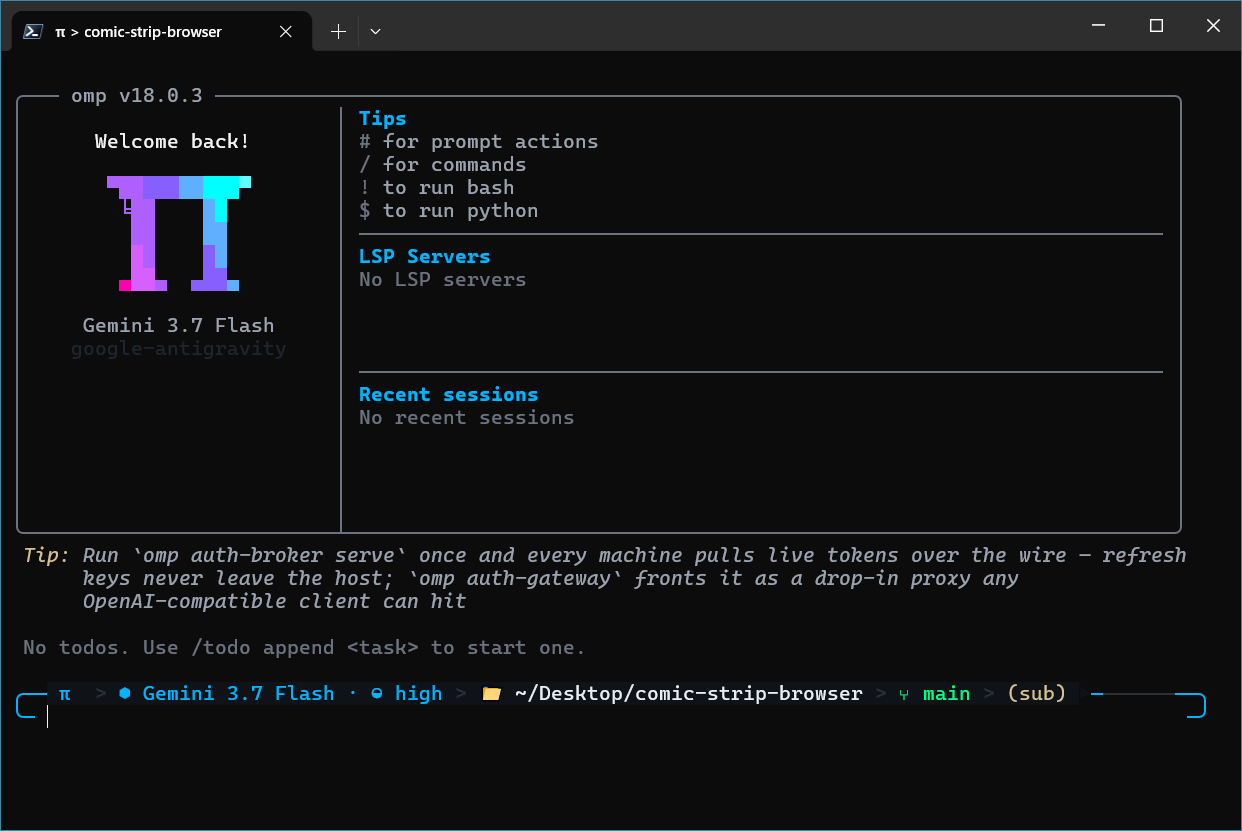
Since Gemini CLI was discontinued, and I noticed how impractical Antigravity CLI (agy) is (Gemini CLI and Qwen Code were gods in comparison!), I had to switch to using Antigravity IDE, which is fine but heavy. I might get used to omp, eh?
🤖
⑦ Aigarius (Aigars Mahinovs): Optimistic take on AI:
As I am writing this, there is a vote ongoing in the Debian project on how to deal with AI in general and AI-assisted contributions to Debian specifically.
This being a long post, I extracted only the beginning of the description for the 8 proposals:
- Proposal A(1) – Action: ban all AI-assisted contributions via Social Contract amendment, except from upstreams (so not rolling back the Linux kernel and other software to “pure”, pre-AI state).
- Proposal B(2) – Action: allow AI-assisted contributions, with conditions of: legality, accountability, disclosure, no uncoordinated bulk actions, privacy.
- Proposal C(3) – Action: reject AI-assisted contributions at Code of Conduct level.
- Proposal D(4) – Action: allow AI-assisted contributions, with conditions of: legality, accountability, disclosure, privacy. IMHO same as B, just shorter.
- Proposal E(5) – Action: no action as such – AI-assisted contributions must follow the same rules as all other contributions and those rules are sufficient.
- Proposal F(6) – Action: discourage AI, but allow it based on existing processes (similar idea to E).
- Proposal G(7) – Action: ban non-humans from directly contributing to Debian. IMHO – another bizarre and self-contradictory option.
- Proposal H(8) – Action: condemn usage, but not actually ban anything. And then it goes on to claim (without any evidence or elaboration) that LLM usage accelerates the destruction of “planet earth” (sic).
I couldn’t be bothered to read all 5,400 words. The entire thing that keeps Debian folk busy is a grotesque masquerade of virtue, IMO.
🤖
⑧ Iustin Pop: Another optimistic take on AI:
AI is useful, even if it has risks
First is, that even if we could put the genie back in the metaphorical bottle, we should not. We do need to continue working towards safe AI, and efficient AI (less environmental impact), but we should not work towards removing the usage of AI. There are already significant advancements in sciences and technology thanks to the use of AI, so desiring AI to not exist (assuming we had a magical wand) is the wrong approach.
Sure, AI has significant risks — and I can see ways in which AI can do significant damage to society — but I don’t think we can go from Kardashev I to II without the use of AI, and definitely not to III. And I think, that should be the goal.
A few simple examples: Do we want to rollback all the 20 years old security issues that AI found? Do we want to rollback the recent Moderna cancer findings? Do we want to rollback the concept of “extremely large scalle pattern matchings”, just because it runs on chips and no longer in one person’s head?
Reading Debian lists
The second point is, lately I found less and less enjoyment in reading Debian lists. Even with that already being the case, I feel soo disconnected from many of the opinions being voiced in this discussion.
On one hand, it’s normal and healthy that people have different opinions, disagree, and move foward.
On the other hand, looking at one of the proposed options:
- “Moderators and disciplinary teams may make narrow and tailored exceptions to rule 4, and decide on interpretation”.
- “Violations of these requirements should be treated as violations of the relevant Code of Conduct and should result in swift and proportionate disciplinary action”.
I already knew Debian, and some large parts of the OSS world, is left leaning. But those phrasings, to me, are too close to socialism/communism. As someone who grew up under communism, this is a much more slippery slope (disciplinary teams? really?) than AI usage. Ask me in person for more details.
So, it is possible that Debian continues to evolve in such a way that I don’t find myself in any way close to its ongoing culture. I will be sad at that point, but it will be what it is.
Where to?
I think that, until such a time that an AI bubble bursts, what any organisation should do is try to logically see where and if AI can help. And in an organisation that is about computer software, I see hundreds of places that are subject to very large scale pattern matching… so the half of the discussion is, to me, mind-boggling.
To be clear, it’s not about “if you can’t beat them, join them”. As I wrote above, I think AI is useful, so the point is how to use it effectively.
Well, will see what Debian votes. I am half curious, half sad already.
The Zane St. John reverse engineering write-up was pretty good! I was already aware of the residential proxy services many years ago around the IoT and Kickstarter craze in the late 2000’s since many of those early devices were being used not only as proxies but also for DDOS services. Cloudflare became popular over night too hint hint… I haven’t kept up with the scene, but back then it was underground and there was no overt marketing or advertising so it’s kind of wild to see it just simply in the open like that now. This is why I never buy this kind of junk.
🌟 Updates on Debian and AI:
– Raphaël Hertzog: Debian’s General Resolution on AI and LLM
– Anarcat: A more nuanced view of LLMs
– LWN: Debian weighs eight options in vote on LLM usage