
Reuters doesn’t understand AI, China, markets, and bubbles
Reuters: In China, the AI bubble has already burst:
Oct 26 (Reuters) – While global tech stocks teeter, in China they have already crashed as lofty valuations collapse under worries about AI demand and curbs on Chinese exports.
The meltdown, tanking the mainland STAR50 index of AI and semiconductor leaders by 40% in less than four months and vaporising some $480 billion in market value, is an ill omen for wobbly world markets and a dampener on China’s efforts at encouraging its savers into stocks to fund the AI boom.
It has also slammed the brakes on a rally running two years, since economic stimulus promises sent shares soaring, and has stalled Beijing’s push to break with a long boom-bust pattern and drive a “slow bull” market that delivers reliable performance. China’s broad blue-chip index has dropped about 20% from highs made in June.
“The stock market later evolved into a speculative crazy bull,” said Beijing-based fund manager Dong Baozhen. “And now we see the bubble bursting.”
The reversal reflects a rally that ran to higher heights than markets in the West or elsewhere in Asia, and compares with a mere prick to US AI stocks, which have led a 6% drawdown in the Nasdaq from a record high scaled three weeks ago.
There has been no obvious selling trigger in China, although traders said high prices, tax bills and the threat of the US or other nations banning Chinese equipment in data centres all contributed.
With AI stocks running to 42% of China’s market capitalisation and 57% of turnover across mainland-listed A-shares and Hong Kong’s H-shares, according to Goldman Sachs, few in a market dominated by small investors have escaped pain.
RETAIL FAVOURITES SLIDE
Shares in robot-maker Unitree, 8,000 times oversubscribed by retail buyers at listing, have halved since they started trading in August, and chipmaker CXMT has lost more than a quarter of its value in the past month.
Chipmakers MetaX Integrated Circuits and Moore Threads Technology, which leapt 700% and 400% respectively on their market debuts last year, have also halved in value since July.
Chen Wensheng, a small business owner and investor from China’s southern Hainan, said he bought into the rally emboldened by what he felt was official support for the likes of Unitree, which counted state-backed funds as investors. But Chen and his friends are now nursing losses.
Frustration that an investment theme backed by Beijing has ended so badly has driven many investors into defensive assets and is likely to slow equity fundraising by tech firms.
Shares in optical parts makers Zhongji Innolight and Eoptolink Technology are down roughly 60% from highs in June and July, in part as Washington moves towards banning the one-time darlings from supplying US data centres.
With the STAR50 index still at around 100 times trailing earnings, albeit down from a high of nearly 250, investors compare the Nasdaq 100’s multiple of 30 and worry the selloff could get worse before it gets better.
“What’s happening is now going to put a stop for many of the companies trying to get themselves listed,” said Hong Hao, managing partner and chief investment officer at Lotus Asset Management in Hong Kong.
‘ALL BUBBLES INEVITABLY BURST’
The frenzy and its fallout contrast with a push by authorities to improve returns and dampen volatility by cracking down on leverage and high-frequency trading. State-backed investors were sellers into rallies to keep gains in check.
China’s market regulator, the China Securities Regulatory Commission, did not immediately reply to questions faxed by Reuters last week.
CRSC Chairman Wu Qing met with market participants earlier this month to hear suggestions on improving capital markets, the regulator said on its website, and some in the investment community say the boom has been bad for the market’s structure.
“Overemphasising the ‘technology content’ — that is, the weighting of tech companies by market value in major indexes — leads to a deviation, even a distortion, in capital behaviour,” said Leo Wang, partner at Beijing-based Qianchuang Capital.
“This created a severe bubble in certain sectors and a serious drain on others.”
Some see value in the selloff, saying it is neither surprising nor detrimental to market reforms that are geared for the long term and have gained traction in driving up returns, particularly income, in recent years.
Although they have been sellers over the past three months, Asia funds in general are overweight on China, according to HSBC research.
Goldman Sachs has Innolight and CXMT among dozens of Chinese AI stocks on a revamped recommendation list it published earlier this month, and BNP Paribas Securities strategist William Bratton has said the market offers buying opportunities for the careful.
Still, on the mainland many are looking at other sectors or for even lower valuations before they turn buyers.
“Just like all other Chinese manufacturers, (chipmakers and AI suppliers) will eventually end up in a price war,” said fund manager Wang Zhuo, partner at Shanghai Zhuozhu Investment Management.
“There’s no exception,” he said. “All bubbles inevitably burst.”
🤖
37 Comments picked up on FB (and corrected for the most blatant spelling and grammar errors):
- In China AI was more about automation and industrial process control than about funny cat animations. It is still alive and well there.
- They passed a law saying AI cannot be used to displace human labor.
- The 50 largest by cap tech + AI linked Chinese companies have dropped 40% in market cap in four months. How is that not a bubble pop?
- So imagine how bad it’s going to be where AI is mainly used for funny cat animations, yet the bubble is even bigger…? (Clue: USA)
- You clearly have no idea how much AI slop is in their AI dramas and movies. Western creatives are still resisting generative AI, while a lot of Chinese actors & directors are out of job. 95% of short dramas are AI generated. Source: https://www.chosun.com/english/industry-en/2026/08/30/LISTE5BKCJFIBMF7LTH3E63G7U/
- Exactly right! It is embedded everywhere! To them it is not about a race to who will win, it is about making life better and being more efficient!
- There is no AI bubble in China. China discourages stock market capitalism.
- Not if it’s a 10% sustained monthly loss. It could easily lose another 30% in the next 3 months.
- Not true. Their AI and semi conductors has fallen 40% in 4 months.
- The fact they are now constructing alot AI DC in South East Asia. Stock fallen doesn’t means stop expanding.
- 40% is called correction, not burst.
- Maybe in your fantasy world. There are plenty of AI businesses in China. Example: Alibaba invested 58 billion this year in AI.
- Over 70 per of Chinese household wealth is parked in property (and stocks) on the advice of government officials. That’s why domestic spending took a hit when the property bubble burst. China is more (state) capitalist than you’d think, with nationalism thrown in to make matters worse when things go wrong.
- Given that China accounts for roughly 32% of global manufacturing output — a scale that enables faster standardization and data aggregation — AI penetration might actually be faster there, delivering higher relative value added than in the more fragmented and shallower North American and European markets. I wouldn’t underestimate this centrally planned system.
- There was no bubble in China, because they didn’t baloon the investments on billions of debt. Most of their investments started to be profitable year in, Deepseek funds next generation by profits from previous one already.
- China’s AI industry shows that hype alone cannot sustain a technology boom. Real innovation, practical applications, and sustainable business models are what truly matter. The big question is: what lessons can the rest of the world learn from this? 🤖📉
- Good for China. The earliest a bubble bursts, the smaller the fall is.
- What about some cryptos then? I have some animated GIFs of dancing robots as NFT. They only cost a few million dollars. Anyone? 😁👏🏻👏🏻
- The Chinese AI economy was far worse overrated than the rest of the world did, that does however not mean what happened in China would not have consequences for stockmarkets around the rest of the world. I suspect valuation turns a lot more strict than it used to be. I hope it will affect the greed rage of these companies in such a way it will benefit the consumers.
- For now, users are reaping the benefits of AI, while companies are at systemic loss. So basically, thanks for all the fish.
- Maybe I’ll get to keep my job after all.
- But the world wants Tulips 😉
- If China’s AI bubble is more about the speed at which valuations have detached from fundamentals, then America’s AI bubble looks more like a systemic risk deeply intertwined with macro credit and capital expenditure. US can’t afford if the AI bubble bursts; however, China could.
- Chinese AI “collapse” meanwhile stocks like Nvidia loses 450 billion in market cap simply due to volatility. Chinese capital markets are not a gauge of its economy, because markets are a tool for China to achieve its economic and political goals, higher prices are not a consideration for policy. Its current market index is still 1/2 of its 2008 peak, but China had already overtaken the US in PPP in 2016 as the largest economy.
- Might that be because they don’t have a ridiculous stock market getting carried away pouring more into the money pit?
- We are waiting for the automotive bubble to burst as well.
- Oh! Propagandabait, that’s new!
- AI is a B2B service which was positioned as B2C for the sole purpose of boosting the IPO.
- Adoption of internet and especially www was a bubble (the dotcom bubble). Lots of bursting bubbles, allegedly. People capitalise on these bubbles when they burst (allegedly), and not only does tech continue to evolve, but hey it creates billionaires and trillionaires right!! Yeah, a sad fact of life. As we are now finding to our cost.
- According to Reuters 😁
- While I’m not a fan of the CCP, the Chinese Stock Market is extremely stagnant: it’s not designed to be used like other countries stock markets. The government controls the capital, that’s all every common person ever needs to ever know.
- AI is a bubble. The only way that these companies can meet their sales targets given their enormous valuations is if they relace all people in all industries they propose to enter because the business model of AI is to replace people in the workplace.
- Of course it’s destined to burst ‘coz they don’t have enough paying customers! Who would buy a dancing robot? Or a robot who can compete in olympics? 🤣
- But they are NOT RULED by Western bankers. You know billions and trillions of debt can be brought back to thin air from which they were created with sign of a pen.
- China didn’t really have a bubble. Fallout was always going to be limited. Automation and clean reliable energy has always and continues to be the short and long-term goal. As opposed to USA that doesn’t have a problem for AI to solve, protects low wage jobs that collect tips and drill baby drill. It’s a massive overhaul of an infrastructure you don’t actively support and a financial ecosystem that is too expensive to replace. You can’t even get self-checkout to work ffs.
- A localized market reset in Shanghai driven by software price wars and export bans is not a global “AI bubble bursting.” It is a localized monetization and sanction bottleneck. Conflating domestic Chinese headwinds with global data center buildouts misreads balance sheet reality. But, it gets eyeballs and hopefully sells subscriptions, right Reuters?
- When the US A.I. bubble bursts, and it will because A.I. is not a product yet, we have a global financial crisis. All major banks are in.
🤖
Meanwhile, here’s the OnTech NYT newsletter that I just received:
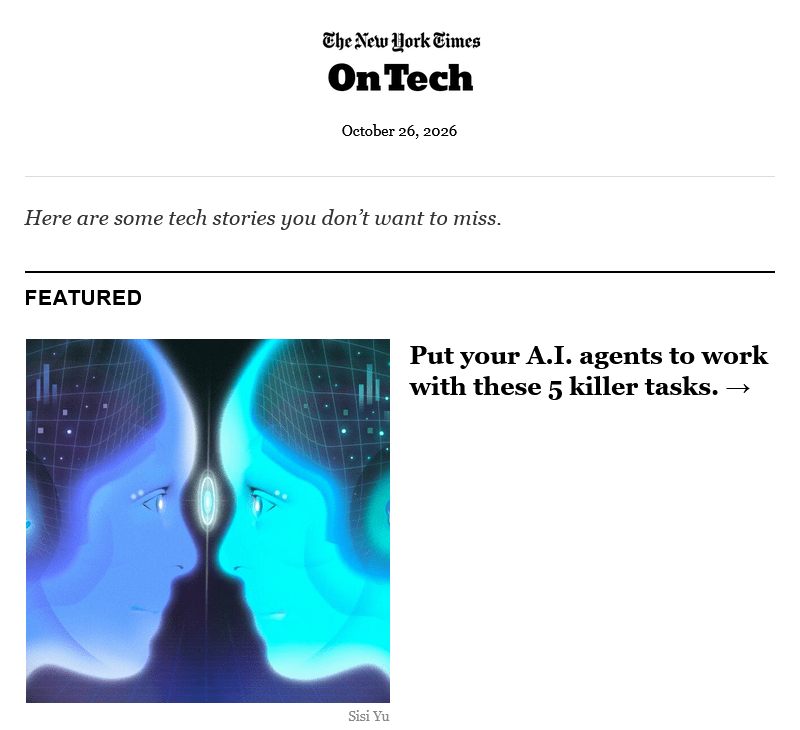
The 5 killer tasks: When you start using Meta’s Muse and OpenAI’s dots for these tasks — like applying for jobs and booking hard-to-get restaurant tables — you may never go back. 🤦♂️ OK, here’s the full list:
- Schedule a Restaurant Booking
- Get a Workout Plan Upon Arriving at the Gym
- Apply for Jobs Faster
- Daily Meal Planning
- Haggle Down Products
No, the West is not retarded. No, no, no, it can’t be. Nor is Brian X. Chen, the NYT’s lead consumer technology writer. Could it be mainly the US?
The newsletter ends like this:
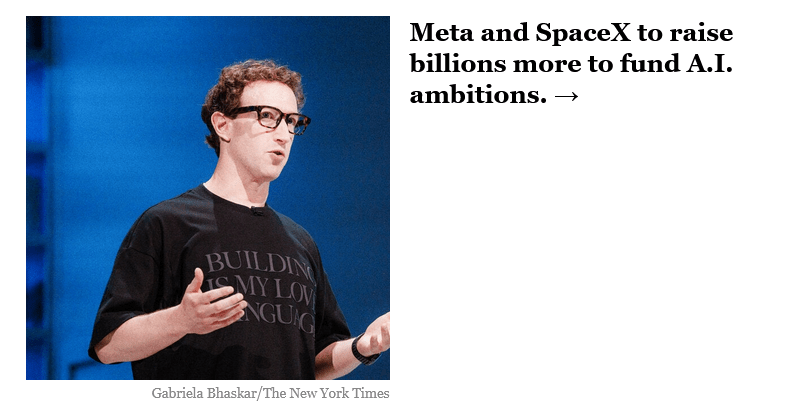
But we have to worry about China, right?
🤖
Oh, I almost forgot! El Trumpo:
When will The Wall Street Journal start calling Artificial Intelligence (AI), a very bad and inaccurate name, SI (Super Intelligence), the name which virtually everyone else is using, or soon will be. In short order, we will be officially BANNING the term, “AI/Artificial Intelligence,” in all relevant documents, and everything else, due to its inaccuracy. Thank you for your attention to this matter. President DONALD J. TRUMP
I suppose he will set up a Gulag for those who still use the term “AI,” eh?
This should complement the previous Executive Order 14,434, “INAUGURATING THE ERA OF SUPER INTELLIGENCE.”
No bubble whatsoever, just SI*.
*also known as the metric system (because Système international d’unités is too French)
Leave a Reply