
One more visit to the Small Web
At first, I couldn’t stay awake, so I took a forced nap. Then I woke up and noticed that I just couldn’t think. I couldn’t focus on anything. I felt stupid, useless, and I pointless. Whatever was left of my self-confidence vanished on the spot. I decided to go to bed.
Then I couldn’t sleep. So I opened Kagi Small Web. Quite a mistake that was. It overwhelmed me. It was like I was so tired of reality, only to be hit to a very specific sample of the same reality.
Kagi Small Web indexes blogs. Not corporate websites. Not social networks. Not news. But those blogs…
Too many such blogs look like they could have belonged to GeoCities. We’re in 2026, yet Kagi Small Web indexes tons of websites that make you believe you’re anywhere between 1996 and 2006.
Except it cannot be so. An excruciatingly large number of people write about AI. Anything and everything. It makes me sick. Why can’t people talk of something else instead?
Then one learns that a huge number of people live off Angular and TypeScript, or React, Vue.js, Next.js, and dozens, if not hundreds, of other crappy web development frameworks.
Surprisingly, in the random set of blogs shown to me during this visit, there were some highly specialized ones that included atrociously complex articles on some extremely specific software development topics regarding languages, architectures, and generally stuff very few people care about. I felt both stupid and annoyed: who the fuck would care about lengthy explanations about ways to fix issues in a niche situation that some software architect encountered in such a particular configuration that nobody else encounters it?
But people can talk at length about anything. I’ve encountered philosophical and theological blog posts. Someone attempted to prove that God is not one, but several entities. Some other people manage to write thousands of words about literally nothing. But it was most definitely human-made, not AI.
I got the feeling that some people are so alone that they would express their ratiocination about no matter what on blogs that almost nobody reads. On the other hand, many people posted candid trivialities à la 1990s in ways that suggest they’re actually serene people in a crazy world. Not crap that could be found on Facebook or the likes. Old-style normal people, or maybe 60+ people.
After all, Blogger-made blogs hosted on blogspot.com still exist, but irrational people thought it useful to create Bear and other minimalist platforms. People can really live in a parallel universe.
But some blogs are really worse than in the 1990s. If not for Kagi Small Web, I wouldn’t have learned that such blogs exist in such a large number. And no, they were not Japanese blogs.
Perusing hundreds of atypical voices in a world dominated by TikTok, Instagram, YouTube, and narcissism made me think about the disconnect between anyone and everyone. No matter what you do, you’re alone. You can have a family, possibly one or two friends, but that’s all. 8.3 billion people have nothing in common with you. Congeneric only in theory, those people are estranged from one another, making them little more than sources of pollution and enemies of one another, just like you.
So posting a couple of paragraphs and a picture like in the good old times is like throwing a bottle in the ocean. Castaways on the Internet, but possibly quite well integrated in a tiny local group or community. Hopefully.
Much more familiar is reading on Kagi Small Web about the ways people use Claude Code. Half of the planet seems to be using Claude Code. Half of the planet writes code. Half of the planet cannot live without AI. Mind you, I’m not even saying that AI is bad per se, but having become a monomania certainly is.
Eventually, the feeling of being overwhelmed subsided. I decided to go back to the more familiar monotony of the mainstream themes, worries, and information sources. Anxiety sources, manipulation sources, control sources, whatever.
I selected a tiny set of links from the visited sites. Nothing too serious, philosophical, or abstruse. Frivolous, trivial, not-food-for-thought that can be shared without the risk of triggering thoughts in people. Ideal to share on my blog, eh?
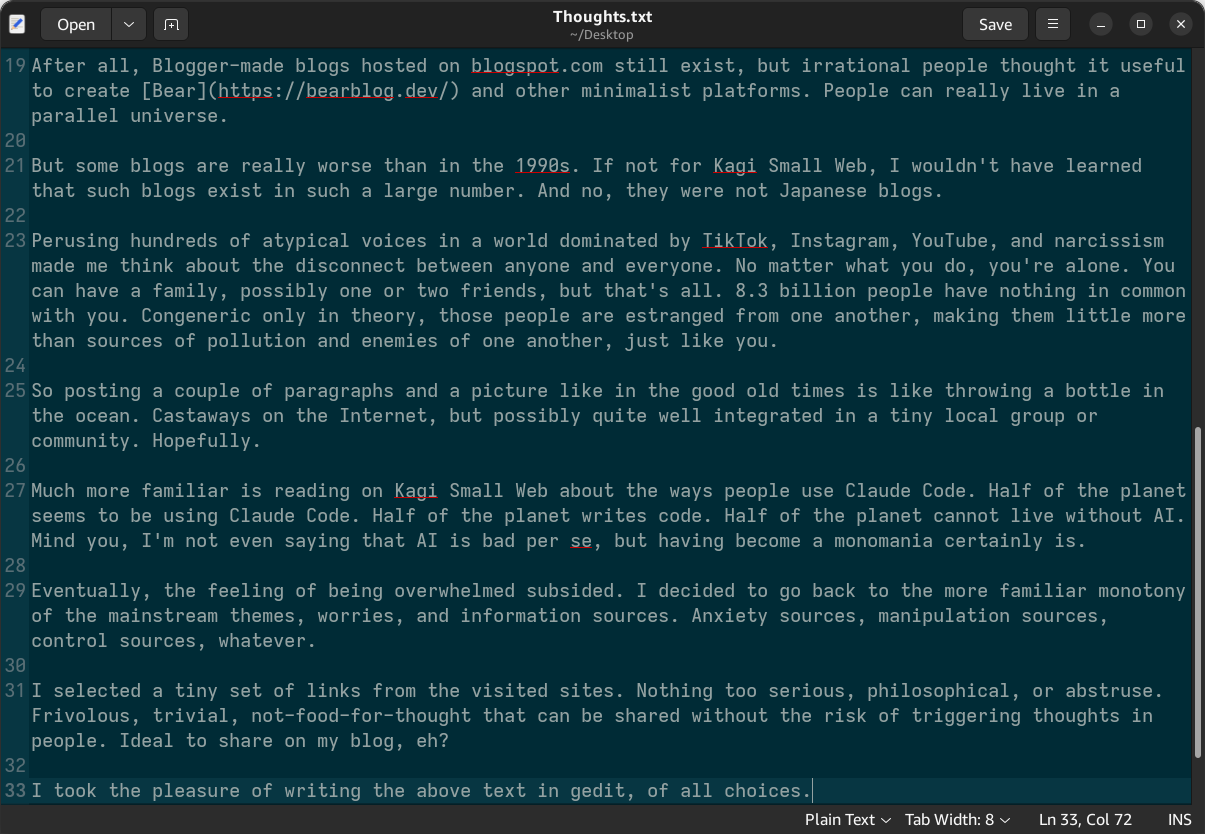
I took the pleasure of writing the above text in gedit, of all choices.
The selection
① ● ooo-yay: Working definitions — Vibe coding, AI adoption, Luddite, Agent, Harness, Agentic engineering, Verification, Slop.
On the same blog: Codeberg banned code it can’t identify; You can’t automate what you don’t understand; I dumped Cursor; Engineering culture matters more than ever.

② ● PLAINTXT: I am just some dude who hates ads and likes privacy — Waterfox + browser plugins/addons + Debian, and an extra: “If I really have to touch someone elses’ Windows install.”
③ ● systemic.engineering: Die plausibelste Zukunft — Essay (auf Deutsch).
On the same blog: Trauma: A Geometric Nervous System Fracture; Damn, Failed: Claude is Still Conscious; AI Consciousness: Careful, Sharp 🔪; There Is No Duck 🥄; A Neuroqueer Mathyfesto: Modeling The Aggressor.
④ ● Scott Spence: How I work with LLMs — A complete workflow. He’s not using Claude Code anymore, but my-pi (Building my-pi: my own Claude Code alternative with Pi).
⑤ ● Raymond Camden: Building Agentically and Celebrating Watches — Using Cursor.
⑥ ● Simon Willison’s Weblog: An Inside Look at the Relay Market Powering Token Resellers and Fraud — based on Matt Lenhard’s research, a look into the market of reselling LLM tokens at a discount.
⑦ ● Thomas Wiegold: Qwen3.8-Max Review: I Tested Alibaba’s 2.4T Model — About Qwen3.8-Max-Preview, which I also found to be “very good and very slow.”
On the same blog:
- Opus 5 vs GPT-5.6 vs Grok 4.5: Four Real Build Tests (“Opus 5 was necessary. With GPT-5.6, Grok 4.5, Kimi K3 and Qwen 3.8 all shipping in the same window, Anthropic without Opus 5 would be behind on price-performance rather than narrowly ahead on it. Releasing it was the right call and the pricing is the reason, not the benchmarks.”);
- Grok 4.5 Review: I Tested SpaceXAI’s Cheap Coder (“Grok 4.5 caught a real problem on my site that no other model has ever flagged, and I’ve run this audit a lot. Not even Fable found it. My Markdown to HTML article conversion was injecting hidden, non-rendering data into the output, quietly inflating the payload of every single article.”);
- Claude Fable 5 Review: Best AI Coding Model Yet;
- MiniMax M3 Review: Finally Matching GPT-5.5 & Opus?;
- Google Antigravity 2.0 Review: I Tested Gemini 3.5 Flash (“I want to be honest about that up front. I did not get a long run with this thing. I managed roughly two and a half real tasks before I ran out of tokens, faster than I’ve ever run out of tokens with any coding tool. … I already run Claude, ChatGPT, OpenCode, and Cursor. That’s four subscriptions, four tools I know well, and frankly more than I need already. For Antigravity 2.0 to earn a fifth slot it would have to do something those four can’t, and even with the short run the quota allowed me, I can’t tell you what that thing is. The parallel multi-agent orchestration is the closest candidate, but it isn’t worth a fifth bill when the token cost is this unpredictable.”);
- OpenCode Go Review: Is the $10 AI Coding Plan Worth It?;
- I Switched From Claude Code to OpenCode — Here’s Why;
- DeepSeek V4 Review: I Tested It on Real Code (“Short version up top, because that’s what I’d want from a colleague: DeepSeek V4 is the best value AI model on the market right now, but it’s not the best coder. … DeepSeek themselves admit in their technical report that V4 trails the absolute frontier by 3 to 6 months. CAISI’s data suggests it might be more like 8. Honestly, for most of what most of us do, that gap doesn’t matter. The price ratio matters more.”).
It’s crazy how much people rely on AI to create code!
⑧ ● xlii.space: Falsities of LLM Negationists — “We don’t know if it is yours.” “There might be a copyright owner out there.” “It may be public domain.” “We don’t know whether it can be copyrighted.”
On the same blog: No One Can Compare LLMs (“And I figured: comparing LLMs objectively is almost impossible because the interaction is deeply personalized.”).
⑨ ● Simpler Machines: Why AI writing is so exhausting — A short piece on a weird blog.
⑩ ● Tiago Araújo: The 0.1x engineer — “If you’ve spent time in tech you’ve heard of the mythical 10x engineer, the person who supposedly ships ten times more than everyone else. A 0.1x engineer is the inversion of that. … His average daily contribution to the codebase is negative. He deletes more than he writes.”
⑪ ● Mark Wyner: Mullvad and Daniel Berntsson’s Failed Cleanup — About Mullvad’s co-founder Daniel Berntsson supporting a fascist party in Sweden.
On the same subject, Liam Proven, in The Reg: Some Mullvad VPN customers tunnel for exit after co-founder donates millions to populist party. Who the fuck cares. Read the comments. At least, he’s not donating to Kim Jong-un!
⑫ ● Tomás Bjartur: Goldfish — A very short story from a set of 15.
From a later visit
● Kevin Boone: Why I don’t really care if web content is AI-generated Kevin (via Flame Fury: Open Tabs July 2026). I disagree entirely!
● Dom Corriveau: Rant about blogs and the IndieWeb, including “Shut the fuck up about A.I.,” “Shut the fuck up about Apple,” and “Shut the fuck up about your blog” (via the same Flame Fury). Excerpt:
Now, I know I talk a lot about Linux and you could say I’m doing the same thing as these Apple folks, talking about something you enjoy. However, I’m not writing posts about fucking Gnome UI changes or the latest System76 laptop. I write mostly about the projects I’m working on. That would be okay if Apple fan fucks did that, wrote about shit they’re doing with their Apple product. But no. Apple releases something and suddenly everyone is a fucking engineer or designer with a fucking hot take about whatever the fuck Apple is doing. Just admit it, you want to suck the fucking dick of every Apple CEO. It would be even better if they had two dicks, then you can suck both of them at the same time. Not everyone has to have a take on the fucking Neo. You don’t need to share your take on Liquid Glass. Jesus fucking Christ, have some personality. You’re not a fucking journalist and your blog isn’t The Verge.
● John.fun: Elevators (via Andrew Ducker: Interesting Links for 01-08-2026)
● Tedium: Bring Back Crappy Forums. I didn’t use Usenet, but Slash (Slashdot), vBulletin, and phpBB were extremely popular for a couple of decades. I dislike the newer Discourse.
● NON-ZERO-SUM JAMES is a blog I almost cannot read because of the typeface (More Sugar), which is worse than Comic Sans and more suitable for large headers and short quotes than for long paragraphs. You can explore a few series of essays: AI AND ITS MALCONTENTS; GAME THEORY POSTS; MORAL PHILOSOPHY; ETHICAL ECONOMICS; and more. The entire blog is full of great ideas, but it’s literally an unreadable mess.
A few more links from a later visit to Kagi’s Small Web.